



Reticulated Cory Catfish – Corydoras Reticulatus
Reticulated Cory Catfish – Corydoras Reticulatus
Couldn't load pickup availability
Quick Care
Essential care information at a glance
What Fish Will I Receive?
What Fish Will I Receive?
Photos represent the species and typical appearance of the fish you will receive. Because Corydoras are living animals, individual size, coloration, markings, and pattern may vary naturally from fish to fish.
Healthy, Active Corydoras
Healthy, Active Corydoras
Every Corydoras offered by Tropicflow Aquatic is selected for healthy body condition, active behavior, clear eyes, intact barbels and fins, and normal swimming behavior before shipping.
Best Substrate for Corydoras
Best Substrate for Corydoras
Fine sand or another smooth, non-abrasive substrate is recommended. Corydoras spend much of their time searching through the substrate with their sensitive barbels.
Acclimation Directions
Acclimation Directions
1 — Open & Inspect
Check your fish immediately after delivery.
2 — Temperature Acclimation
Float the closed bag for approximately 15–20 minutes.
3 — Gradually Introduce Tank Water
Slowly add small amounts of aquarium water.
4 — Transfer the Fish
Gently move the Cory into the aquarium without pouring shipping water into the tank.
Keep aquarium lights low during the first several hours and allow the fish time to settle.
Flat Rate Shipping As Low As $25
Flat Rate Shipping As Low As $25
At Tropicflow, we strive to make the shipping process as affordable and convenient as possible for our customers. Our flat rate shipping starts as low as $25, and the more fish you purchase, the more you save on shipping fees. We encourage our customers to combine as many fish as possible in each order to take advantage of these cost-saving opportunities.
The Reticulated Cory Catfish (Corydoras reticulatus), also known as the Reticulated Cory or Mosaic Cory, is a beautifully patterned South American armored catfish recognized by its silver-gray body, metallic green sheen, intricate black net-like markings, banded tail, and dark dorsal-fin patch. Native to the Amazon River basin, this peaceful species reaches approximately 2.25–2.5 inches and should be maintained in groups of at least 6 fish. Fine sand, clean stable water, good oxygenation, and peaceful community tank mates make an excellent long-term setup.
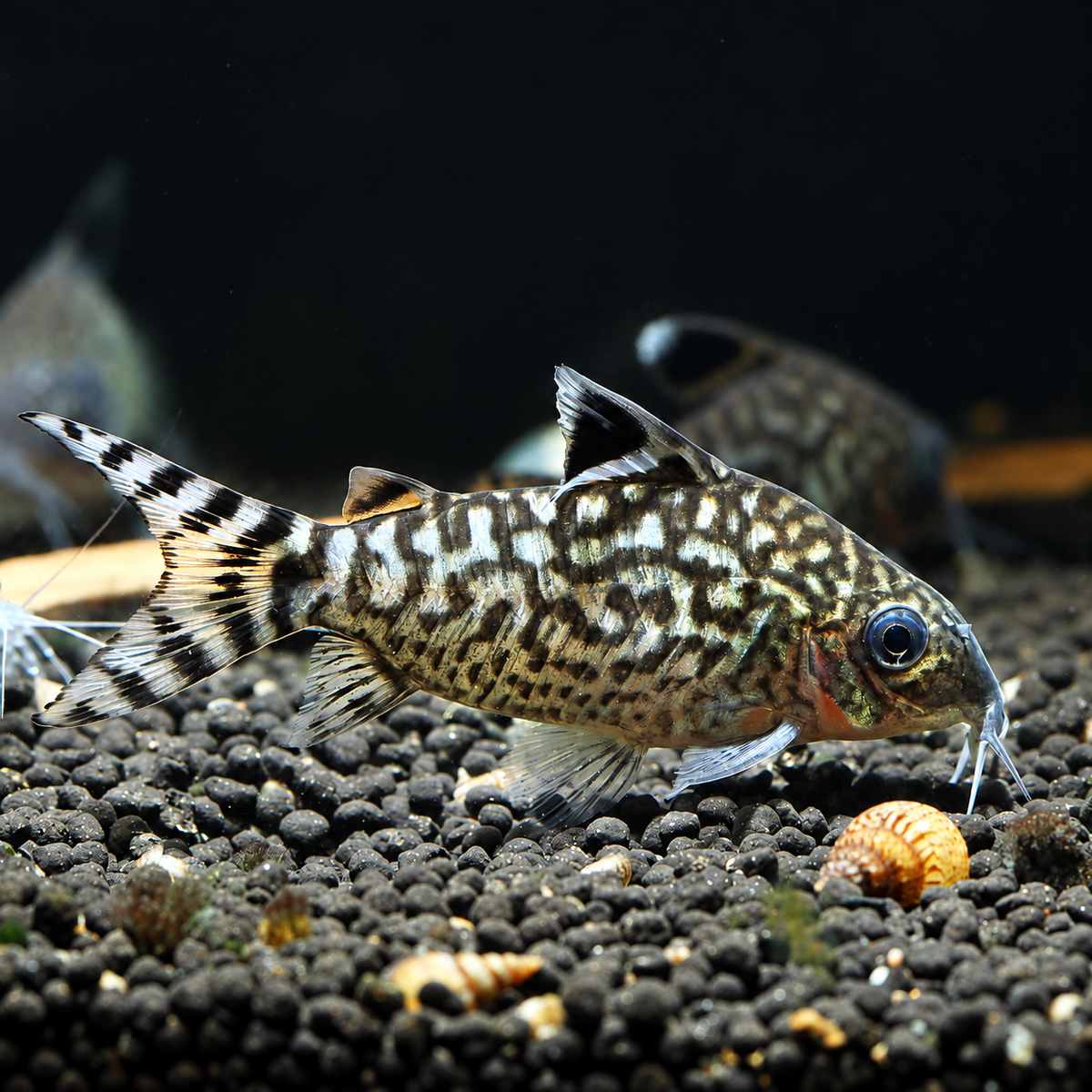
The Reticulated Cory Catfish (Corydoras reticulatus) is a distinctive Cory-type catfish prized for one of the most intricate body patterns in the group.
Also known as the Reticulated Corydoras, Network Cory, or Mosaic Cory, this species develops numerous dark curved lines and interconnected markings across a pale silver-gray body.
These markings form a complex reticulated or mosaic-like pattern, while the caudal fin develops multiple dark transverse bands. Healthy adults can also show an attractive metallic green or bronze sheen under aquarium lighting.
Taxonomy note: This fish was historically and commercially known as Corydoras reticulatus. Following the major 2024 revision of Corydoradinae, it was transferred into the expanded genus Brochis. Its currently accepted scientific name is Brochis reticulata. The traditional name Corydoras reticulatus remains highly useful for aquarium identification and online search recognition.
Reticulated Cory Catfish Care Information
| Care Requirement | Reticulated Cory Information |
|---|---|
| Common Name | Reticulated Cory, Reticulated Corydoras, Mosaic Cory, Network Cory |
| Traditional Scientific Name | Corydoras reticulatus |
| Current Scientific Name | Brochis reticulata |
| Adult Size | Approximately 2.25–2.5 inches |
| Temperature | 72–79°F (22–26°C) |
| pH Range | 6.0–7.2 |
| Water Hardness | Soft to Moderately Hard |
| Recommended Tank Size | 20–30+ Gallons Recommended |
| Recommended Group Size | 6+ Recommended |
| Temperament | Peaceful & Social |
| Diet | Omnivore / Benthic Forager |
| Tank Level | Bottom Dweller |
| Care Level | Beginner to Intermediate |
| Origin | Amazon River Basin — Brazil, Colombia & Peru |
What Does a Reticulated Cory Catfish Look Like?
The Reticulated Cory Catfish has a compact, relatively deep Cory-type body with a pale silver-gray, cream, or light bronze base color.
Across this light background are numerous dark curved lines, worm-like bands, and interconnected markings that create the netted or mosaic appearance responsible for the species' common name.
The head and upper back are generally darker, while the lower body may display straighter black lines over a pale background.
Healthy specimens can develop a beautiful metallic green, olive, or bronze shimmer, especially across the sides of the body.
Why Is It Called the Reticulated Cory?
The word reticulated means patterned like a network or net.
Rather than having isolated round spots or a single solid stripe, Corydoras reticulatus develops interconnected dark lines and irregular bands across much of the body.
These markings can create a maze-like or mosaic appearance, which is why the species is also commonly called the Mosaic Cory or Network Cory.
Look for the combination of a silver-gray body, black net-like mosaic markings, dark dorsal-fin patch, and strongly banded tail fin. Individual fish can vary naturally in how dense or connected the reticulated pattern appears.
The Banded Tail of the Reticulated Cory
The tail fin is another important identification feature of Brochis reticulata.
Dark markings follow the caudal-fin rays and can form approximately six to eight transverse rows or bands across the tail.
The alternating black and pale pattern adds to the overall mosaic effect and helps distinguish this species from Corys with clear or lightly spotted caudal fins.
Reticulated Cory Dorsal Fin Pattern
Reticulated Corys typically develop a dark black patch around the middle of the dorsal fin, sometimes accompanied by scattered additional pigmentation.
This dorsal marking, combined with the complex body reticulation and banded tail, creates a pattern that remains visually interesting from nearly every viewing angle.
Is Corydoras Reticulatus Now Brochis Reticulata?
Yes. This fish was historically classified as Corydoras reticulatus.
Modern phylogenomic research showed that the traditional broad Corydoras genus contained several distinct evolutionary lineages.
In the major 2024 revision of Corydoradinae, Corydoras reticulatus was placed in Brochis Lineage 8, sub-clade 3.
Its currently accepted scientific name is therefore Brochis reticulata.
Notice that the species ending changes from reticulatus to reticulata when combined with the genus Brochis.
Why Is the Reticulated Cory a Brochis?
The modern genus Brochis now contains more Cory-type catfish than the small group traditionally called Brochis in older aquarium books.
Genetic and morphological studies demonstrated that Reticulated Corys belong within this larger evolutionary lineage rather than the lineage containing the type species of Corydoras.
This is why modern scientific databases now list the fish as Brochis reticulata, even though Corydoras reticulatus remains the familiar aquarium name.
Do Reticulated Corys Have Different Patterns?
Yes. Specialist Cory references have documented noticeable variation in body markings and overall size among fish identified as Brochis reticulata.
Some individuals have extremely dense, interconnected black markings, while others show a lighter or more open reticulated pattern.
Pattern differences may reflect normal geographic variation, individual variation, or populations requiring additional taxonomic study.
For serious collectors and breeding projects, preserving locality and breeder information can therefore be useful.
Where Do Reticulated Cory Catfish Come From?
Current major taxonomic references place Brochis reticulata within the Amazon River basin of Brazil, Colombia, and Peru.
Particularly well-documented aquarium localities occur in Peru, including the Rio Ampiyacu, a tributary of the Amazon near Pebas, and the Rio Tamaya, a tributary of the Rio Ucayali near Masisea.
Because the species occurs across a broad Amazonian region, slight geographic differences in pattern should not automatically be interpreted as separate species without supporting evidence.
Reticulated Cory Behavior & Group Size
Reticulated Corys are peaceful, social bottom-dwelling fish and should not be maintained individually.
Keep at least 6 Reticulated Cory Catfish together. Larger groups are even better when aquarium size allows.
A proper group generally encourages more confident activity, natural foraging behavior, and increased visibility around the aquarium.
Like other Corydoradinae catfish, Reticulated Corys may occasionally swim rapidly to the water surface to gulp atmospheric air before returning to the substrate. Occasional surface visits are normal.
Ideal Aquarium Setup for Reticulated Cory Catfish
A 20–30 gallon or larger aquarium is a practical starting point for a group of six or more Reticulated Corys.
A footprint around 24 × 15 inches or larger provides useful horizontal bottom space for natural group foraging.
A fine sand substrate is ideal. Smooth rounded fine gravel may also be used if kept very clean, but sharp or abrasive substrate should be avoided.
Driftwood, smooth rocks, dried leaves, live plants, and shaded areas can provide shelter while open sections of sand allow the group to search naturally for food.
Good surface movement and effective filtration help maintain the clean, oxygen-rich conditions preferred by active Cory-type catfish.
Reticulated Cory Water Parameters
Reticulated Cory Catfish generally do well at approximately 72–79°F (22–26°C).
A practical pH range is approximately 6.0–7.2 for aquarium maintenance.
The species can tolerate a reasonable range of hardness, but stable water quality is more important than attempting to continually adjust the aquarium to one exact number.
Maintain the aquarium fully cycled with effective biological filtration and regular partial water changes. Ammonia and nitrite should remain at zero.
Poorly maintained substrate and excessive accumulated organic waste should be avoided.
What Do Reticulated Cory Catfish Eat?
Reticulated Corys are omnivorous benthic foragers and should receive a varied diet specifically provided for them.
Their natural diet includes small animal material such as worms, crustaceans, and aquatic insects along with other edible organic matter.
In the aquarium, feed a combination of:
- High-quality sinking pellets
- Bottom-feeder tablets or granules
- Bloodworms
- Blackworms
- Brine shrimp
- Daphnia
- Tubifex
- Other appropriately sized frozen or live foods
A varied diet supports healthy growth, breeding condition, and the strong metallic coloration seen in well-conditioned adults.
Reticulated Cory Catfish Tank Mates
The peaceful temperament of the Reticulated Cory Catfish makes it suitable for many freshwater community aquariums.
Potential tank mates include peaceful tetras, rasboras, pencilfish, danios, smaller barbs, peaceful dwarf cichlids, gouramis, and other non-aggressive freshwater fish with compatible water requirements.
Other compatible Cory-type catfish can also work well, but they do not replace the need for a proper social group of Reticulated Corys themselves.
Avoid large predators, aggressive bottom dwellers, and highly territorial species that may intimidate or injure them.
Male vs. Female Reticulated Cory Catfish
Mature Reticulated Corys become easier to sex once they reach adult size.
Adult males generally remain slimmer and may reach approximately 2.25 inches.
Adult females can reach around 2.5 inches and usually develop a broader, rounder abdomen, especially when viewed from above.
Body shape is generally more reliable for sexing than the reticulated color pattern, since both males and females display the characteristic mosaic markings.
Why Choose Reticulated Cory Catfish?
- Intricate black net-like body pattern
- Metallic green and silver-gray coloration
- Beautifully banded caudal fin
- Distinctive dark dorsal-fin marking
- Peaceful social temperament
- Manageable adult size around 2.25–2.5 inches
- Interesting Amazon River basin origin
- Current placement in the genus Brochis
- Excellent choice for planted and community aquariums
Before Buying Reticulated Cory Catfish
Reticulated Corys are social fish and should not be kept alone. Plan to keep at least 6 fish and introduce them only to a mature, fully cycled aquarium. Provide fine sand, clean stable water, good oxygenation, peaceful tank mates, natural cover, and a varied diet. Expect some natural variation in the density and shape of the reticulated body markings between individual fish.
Reticulated Cory Catfish FAQ
What is a Reticulated Cory Catfish?
The Reticulated Cory is a peaceful South American armored catfish traditionally known as Corydoras reticulatus. It is famous for its intricate black net-like markings, metallic body sheen, dark dorsal patch, and strongly banded tail.
Is Corydoras reticulatus now Brochis reticulata?
Yes. Following the 2024 revision of Corydoradinae, Corydoras reticulatus was transferred to the genus Brochis. Its current accepted name is Brochis reticulata.
Is Reticulated Cory the same as Mosaic Cory?
Yes. Reticulated Cory, Mosaic Cory, Network Cory, and Reticulated Corydoras are aquarium names commonly used for Brochis reticulata.
Why is it called the Reticulated Cory?
“Reticulated” means net-like. The fish develops numerous dark, interconnected lines across its pale body, creating a pattern that resembles a network or mosaic.
What does a Reticulated Cory look like?
It has a pale silver-gray body with metallic green highlights, intricate black worm-like or netted markings, a dark patch on the dorsal fin, and multiple black-and-pale bands across the tail.
Do Reticulated Corys all have the same pattern?
No. Natural variation occurs in the density, shape, and arrangement of the dark body markings. Some specimens have very dense reticulation while others show a more open mosaic pattern.
How big do Reticulated Cory Catfish get?
Adult males are commonly around 2.25 inches, while females may reach approximately 2.5 inches. FishBase records a maximum standard length of roughly 6.1 cm.
How many Reticulated Corys should be kept together?
Keep at least 6 Reticulated Corys together. They are naturally social and generally display more confident, active behavior in a proper group.
What temperature is best for Reticulated Cory Catfish?
A practical aquarium temperature range is approximately 72–79°F (22–26°C), with a pH around 6.0–7.2.
Where do Reticulated Cory Catfish come from?
Current taxonomic records place Brochis reticulata in the Amazon River basin of Brazil, Colombia, and Peru. Well-documented Peruvian localities include the Rio Ampiyacu and Rio Tamaya systems.
Are Reticulated Cory Catfish peaceful?
Yes. Reticulated Corys are peaceful social catfish and work well with calm freshwater community fish that share compatible temperature and water requirements.
What do Reticulated Cory Catfish eat?
Reticulated Corys are omnivorous foragers. Feed quality sinking pellets, granules, or tablets supplemented with frozen or live foods such as bloodworms, blackworms, brine shrimp, daphnia, and Tubifex.
Do Reticulated Corys clean the aquarium?
Reticulated Corys naturally forage along the aquarium floor but should not be treated as aquarium maintenance animals. They require intentional feeding with nutritious foods along with regular water changes and normal substrate cleaning.
Reticulated Cory Catfish at Tropicflow Aquatic
Add an intricate living mosaic to your freshwater aquarium with the Reticulated Cory Catfish. With its complex net-like pattern, metallic green-silver sheen, beautifully banded tail, peaceful temperament, and fascinating Amazonian origin, Corydoras reticulatus is an excellent choice for Cory enthusiasts, planted aquariums, and peaceful freshwater community tanks.

Customer Review


