



CW217 Rio Tomo Concolor Cory Catfish – Hoplisoma sp. CW217
CW217 Rio Tomo Concolor Cory Catfish – Hoplisoma sp. CW217
Couldn't load pickup availability
Quick Care
Essential care information at a glance
What Fish Will I Receive?
What Fish Will I Receive?
Photos represent the species and typical appearance of the fish you will receive. Because Corydoras are living animals, individual size, coloration, markings, and pattern may vary naturally from fish to fish.
Healthy, Active Corydoras
Healthy, Active Corydoras
Every Corydoras offered by Tropicflow Aquatic is selected for healthy body condition, active behavior, clear eyes, intact barbels and fins, and normal swimming behavior before shipping.
Best Substrate for Corydoras
Best Substrate for Corydoras
Fine sand or another smooth, non-abrasive substrate is recommended. Corydoras spend much of their time searching through the substrate with their sensitive barbels.
Acclimation Directions
Acclimation Directions
1 — Open & Inspect
Check your fish immediately after delivery.
2 — Temperature Acclimation
Float the closed bag for approximately 15–20 minutes.
3 — Gradually Introduce Tank Water
Slowly add small amounts of aquarium water.
4 — Transfer the Fish
Gently move the Cory into the aquarium without pouring shipping water into the tank.
Keep aquarium lights low during the first several hours and allow the fish time to settle.
Flat Rate Shipping As Low As $25
Flat Rate Shipping As Low As $25
At Tropicflow, we strive to make the shipping process as affordable and convenient as possible for our customers. Our flat rate shipping starts as low as $25, and the more fish you purchase, the more you save on shipping fees. We encourage our customers to combine as many fish as possible in each order to take advantage of these cost-saving opportunities.
The CW217 Rio Tomo Concolor Cory Catfish (Hoplisoma sp. CW217) is a recently introduced and still undescribed collector Cory from a tributary of the Rio Tomo in eastern Colombia. Closely resembling the Slate Cory (Hoplisoma concolor) in body shape, CW217 stands apart through its more contrasting two-tone coloration and distinctive locality. Adults reach approximately 2.25–2.75 inches and should be kept in groups of at least 6 fish, with larger groups preferred. Provide fine sand, clean oxygen-rich water, natural cover, and peaceful tank mates.
The CW217 Rio Tomo Concolor Cory Catfish (Hoplisoma sp. CW217) is one of the newest specialty Cory-type catfish to enter the aquarium hobby. First widely documented from recent Colombian imports, this unusual fish immediately attracted attention because it combines the familiar deep-bodied appearance of the Slate Cory with a much more contrasting color pattern.
Also known as the Rio Tomo Cory, Rio Tomo Concolor Cory, Two-Tone Concolor Cory, or simply CW217 Cory, this fish comes from a small tributary of the Rio Tomo in eastern Colombia.
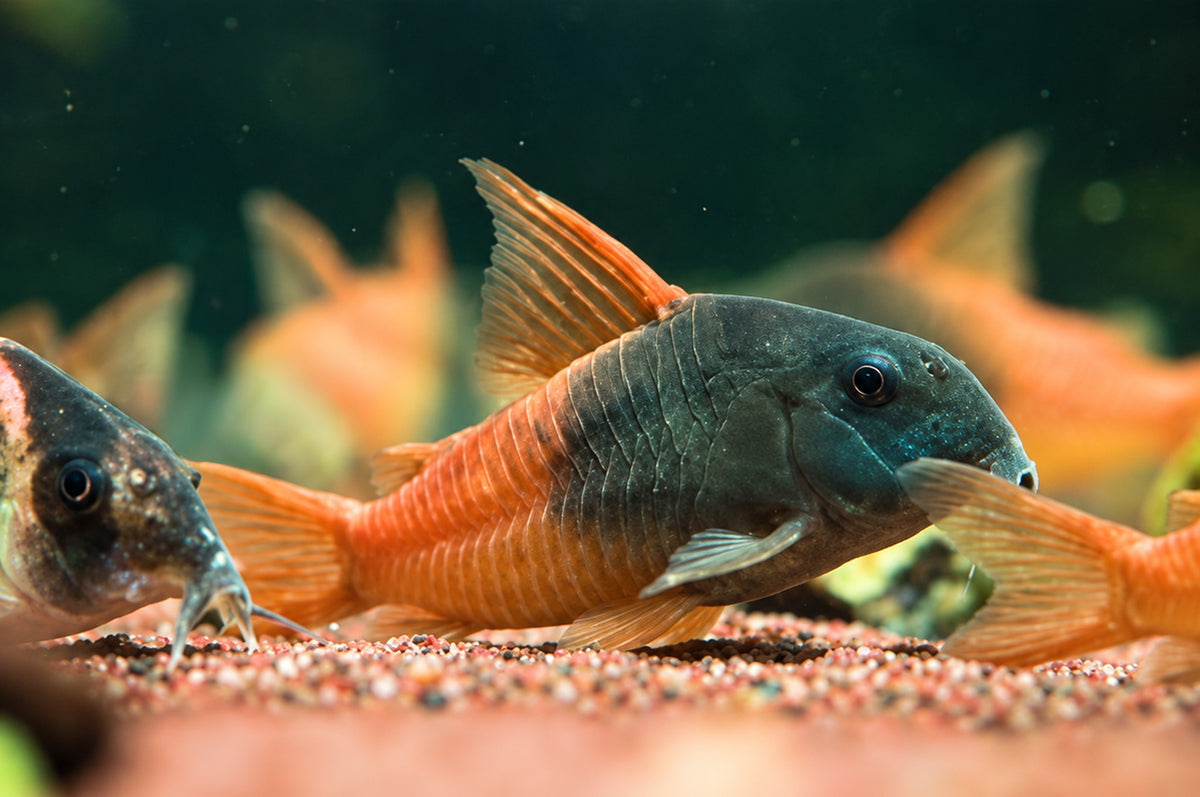
The fish is generally described as having an olive, bronze, slate-gray, or metallic anterior body with warmer brown, rust, orange, or reddish tones becoming more visible toward the rear of the body and fins. Individual coloration can vary with age, sex, lighting, stress, and overall condition.
Taxonomy note: CW217 has not yet received a formal species description and should therefore be listed as Hoplisoma sp. CW217. It is clearly very close to Hoplisoma concolor, but current specialist information treats CW217 as a geographically distinct Rio Tomo population rather than simply assuming it is the same species. Until formal taxonomic work is completed, the CW217 designation is the most useful and accurate identification.
CW217 Rio Tomo Concolor Cory Care Information
| Care Requirement | CW217 Rio Tomo Cory Information |
|---|---|
| Common Name | Rio Tomo Concolor Cory, Rio Tomo Cory, Two-Tone Concolor Cory |
| Scientific / Hobby Name | Hoplisoma sp. CW217 |
| Affinity | Hoplisoma sp. aff. concolor |
| CW Number | CW217 |
| Status | Undescribed Corydoradinae Form |
| Adult Size | Males ~2.25 inches; Females up to ~2.75 inches |
| Temperature | 71–77°F (22–25°C) |
| pH Range | 6.0–7.5 |
| Water Preference | Clean, Soft to Moderately Soft Water |
| Recommended Tank Size | 30+ Gallons Recommended |
| Recommended Group Size | 6+ Minimum; 8+ Preferred |
| Temperament | Peaceful & Social |
| Diet | Omnivore / Benthic Forager |
| Tank Level | Bottom Dweller |
| Care Level | Intermediate |
| Origin | Caño Negro, Tributary of the Rio Tomo, Eastern Colombia |
What Does a CW217 Rio Tomo Concolor Cory Look Like?
The CW217 Rio Tomo Cory has a robust, short-snouted body shape very similar to the classic Slate Cory, Hoplisoma concolor.
Its coloration, however, is noticeably more contrasting. The front half of the body is often described as slate-gray, metallic gray, olive, bronze, or bluish-gray, while warmer brown, rust, copper, orange, or reddish tones may become increasingly visible toward the rear portion of the fish and its fins.
This creates the characteristic two-tone appearance that has made CW217 especially desirable among Cory collectors.
Individual intensity can vary considerably. Aquarium lighting, substrate color, maturity, sex, shipping stress, diet, and overall condition can all affect how strongly the contrasting colors appear.
Why Is CW217 Called the Two-Tone Concolor Cory?
CW217 closely resembles Hoplisoma concolor in overall body shape but displays a much stronger division between cooler metallic body tones and warmer coloration toward the rear.
This contrasting appearance led aquarists to use names such as Two-Tone Concolor Cory and Rio Tomo Concolor Cory.
CW217 is prized for its stronger two-tone coloration compared with typical Hoplisoma concolor. Expect natural individual variation rather than identical colors on every fish.
CW217 Rio Tomo Cory vs. Slate Cory
The CW217 Rio Tomo Cory is extremely similar in body shape to the Slate Cory (Hoplisoma concolor), which is why early hobby references commonly describe it as Hoplisoma sp. aff. concolor.
The major visible difference is coloration. Typical H. concolor tends to display relatively uniform slate-gray, olive, brown, or bronze coloration.
CW217 displays a much more obvious contrasting or two-tone color pattern. According to information from the original importer, fish displaying the CW217 coloration were not found mixed among ordinary H. concolor.
For this reason, CW217 should not simply be labeled Hoplisoma concolor until formal taxonomic work confirms its relationship.
Is CW217 a New Cory Catfish?
CW217 is a very recent addition to the aquarium hobby. The fish received the CW217 identification code in 2025 after newly imported specimens attracted attention from Cory specialists.
It remains an undescribed form, meaning that no formal scientific species description has yet established whether it represents a separate species, a geographically isolated population, or another taxonomic form closely related to Hoplisoma concolor.
Until that work is completed, Hoplisoma sp. CW217 is the most appropriate name for aquarium use.
What Does CW217 Mean?
CW217 is the identification number assigned to this fish through the Corydoras World CW-number system.
CW numbers allow aquarists, breeders, importers, and researchers to consistently identify undescribed Corydoradinae populations before they receive formal scientific species names.
Maintaining the CW217 designation is particularly important because the fish is closely related to other concolor-like Corys and could otherwise be easily confused with them.
Is the CW217 Rio Tomo Cory Rare?
CW217 remains a rare specialty fish in the aquarium trade. The initial known imports consisted of relatively small numbers of wild-collected fish, and availability remains much more limited than established species such as Panda, Bronze, Sterbai, or Slate Corys.
As captive breeding becomes established, aquarium availability may eventually increase.
The term “rare” here refers to current aquarium-trade availability and should not automatically be interpreted as a conservation-status classification.
CW217 Rio Tomo Cory Behavior & Group Size
CW217 Corys are peaceful, social bottom-dwelling fish and should not be maintained alone.
Keep at least 6 CW217 Rio Tomo Corys together. Groups of 8 or more are preferred whenever aquarium size and availability allow.
A proper group encourages more confident behavior and allows the fish to forage, rest, and explore together naturally.
Like other Cory-type catfish, CW217 may occasionally swim rapidly to the surface to gulp atmospheric air before returning to the bottom. Occasional surface visits are normal.
Ideal Aquarium Setup for CW217 Rio Tomo Concolor Cory
Because mature females may approach 2.75 inches, a 30-gallon or larger aquarium is recommended for a proper group.
Prioritize horizontal bottom space rather than tank height. A longer aquarium gives these active Corys more room to forage together.
A fine sand substrate is highly recommended. Cory-type catfish naturally use their barbels and snouts to search through the substrate for food.
Driftwood, smooth stones, roots, dried leaves, and live plants can provide shelter while open sections of sand give the group plenty of usable foraging space.
Natural Habitat of the CW217 Rio Tomo Cory
Current locality information indicates that CW217 comes from a small tributary of the Rio Tomo in eastern Colombia. Local collectors refer to the tributary as Caño Negro.
The water at the collection locality has been described as clear or crystal-clear. The Rio Tomo itself belongs to the greater Orinoco River system.
Importer information also indicates that CW217 was the only Cory-type armored catfish found at that specific collection site and that typical Hoplisoma concolor was not present there.
CW217 Rio Tomo Cory Water Parameters
Current specialist aquarium records recommend approximately 71–77°F (22–25°C) with a pH around 6.0–7.5.
Because CW217 is newly imported and species-specific ecological data remain limited, aquarists should prioritize clean, stable, oxygen-rich water rather than attempting extreme water chemistry.
Keep the aquarium fully cycled with effective biological filtration. Ammonia and nitrite should remain at zero, and sudden changes in temperature or water chemistry should be avoided.
Regular water changes and a clean substrate are especially important for wild-origin or recently imported collector Corys.
What Do CW217 Rio Tomo Cory Catfish Eat?
Species-specific dietary studies have not yet been published for CW217, but its feeding requirements are consistent with other Hoplisoma Corys.
Feed a varied diet containing quality sinking foods along with appropriately sized frozen or live foods such as:
- High-quality sinking Cory pellets
- Bottom-feeder tablets
- Bloodworms
- Blackworms
- Brine shrimp
- Daphnia
- Tubifex
Wild-origin fish may respond especially well to frozen or live foods during the initial acclimation period before readily accepting prepared diets.
CW217 Rio Tomo Cory Tank Mates
The peaceful temperament of Hoplisoma sp. CW217 makes it suitable for carefully planned freshwater community aquariums.
Potential tank mates may include peaceful tetras, pencilfish, rasboras, danios, peaceful dwarf cichlids, other compatible Cory-type catfish, and other non-aggressive freshwater fish that share similar temperature and water requirements.
Avoid large predatory fish, aggressive bottom dwellers, and excessively competitive species that may intimidate CW217 or prevent the group from receiving enough food.
Male vs. Female CW217 Rio Tomo Cory
Adult CW217 can show useful differences between males and females.
Males generally remain smaller and slimmer, reaching approximately 2.25 inches. Mature males may develop noticeably elongated dorsal fins and have longer, more pointed pelvic fins.
Females can approach approximately 2.75 inches and typically become broader and heavier through the body. Their pelvic fins are generally shorter and more rounded.
Dorsal-fin length alone should not be used to determine sex because individual variation occurs.
Why Choose CW217 Rio Tomo Concolor Cory?
- New and highly collectible CW-number Cory
- Distinctive two-tone metallic coloration
- Closely related in appearance to the Slate Cory
- Unique Rio Tomo / Caño Negro locality
- Peaceful temperament for community aquariums
- Active and entertaining bottom-foraging behavior
- Potential extended dorsal fin in mature adults
- Social behavior when maintained in a proper group
- Excellent specialty fish for serious Cory enthusiasts
Before Buying CW217 Rio Tomo Concolor Cory
CW217 is a newly introduced and still undescribed collector Cory. Keep at least 6 fish, with larger groups preferred, and introduce them only to a mature, fully cycled aquarium. Provide fine sand, excellent water quality, good oxygenation, peaceful tank mates, and a varied diet. Because this is a CW-number locality fish, maintaining accurate identification and avoiding unnecessary mixing with similar concolor-type Corys is especially valuable for future breeding efforts.
CW217 Rio Tomo Concolor Cory FAQ
What is a CW217 Rio Tomo Concolor Cory Catfish?
CW217 is a recently introduced, undescribed Cory-type catfish from a tributary of the Rio Tomo in eastern Colombia. It closely resembles Hoplisoma concolor but displays a more contrasting two-tone coloration and is currently identified as Hoplisoma sp. CW217.
What does CW217 mean?
CW217 is the Corydoras World identification number assigned to this undescribed fish. The CW number allows aquarists and breeders to identify the population consistently before it receives a formal scientific species name.
Is CW217 the same as Hoplisoma concolor?
Not currently. CW217 is clearly closely related to Hoplisoma concolor, but it remains an undescribed and geographically distinct Rio Tomo form. Until formal taxonomic work determines its exact status, it is better identified as Hoplisoma sp. CW217 rather than simply H. concolor.
Why is CW217 called the Rio Tomo Concolor Cory?
The name refers to both its collection locality near the Rio Tomo and its strong physical resemblance to the Slate Cory, Hoplisoma concolor.
Why is CW217 called the Two-Tone Concolor Cory?
CW217 can display cooler metallic slate, gray, or olive coloration toward the front of the body with warmer rust, bronze, orange, or reddish tones toward the rear, creating a distinctive two-tone appearance.
How big do CW217 Rio Tomo Corys get?
Specialist records give approximately 2.25 inches for males and up to around 2.75 inches for females. Adult females are typically broader and heavier-bodied.
How many CW217 Corys should be kept together?
Keep at least 6 CW217 Corys together. Groups of 8 or more are preferred when aquarium size and availability allow.
What temperature is best for CW217 Rio Tomo Corys?
Current specialist aquarium records recommend approximately 71–77°F (22–25°C), with a pH around 6.0–7.5.
Where do CW217 Rio Tomo Corys come from?
CW217 comes from Caño Negro, a small tributary of the Rio Tomo in eastern Colombia. The Rio Tomo belongs to the Orinoco drainage.
Is the CW217 Rio Tomo Cory rare?
Yes, CW217 is currently uncommon in the aquarium trade and remains a specialty collector fish. Known imports have been relatively limited. This use of “rare” refers to aquarium availability rather than an official conservation classification.
Can male CW217 Corys develop long dorsal fins?
Yes. Mature males frequently develop elongated dorsal fins and longer, more pointed pelvic fins. However, not every fish with a shorter dorsal fin is necessarily female, so body shape and pelvic-fin structure should also be considered.
Are CW217 Rio Tomo Cory Catfish peaceful?
Yes. CW217 is a peaceful social Cory and can work well in freshwater community aquariums containing other calm, non-aggressive species with compatible water requirements.
What do CW217 Rio Tomo Cory Catfish eat?
Feed a varied diet containing quality sinking pellets or tablets supplemented with frozen or live foods such as bloodworms, blackworms, brine shrimp, daphnia, and Tubifex.
Do CW217 Corys clean the aquarium?
CW217 naturally forage along the aquarium floor, but they should not be considered aquarium maintenance animals. They require intentional feeding with nutritious foods along with regular water changes and normal substrate cleaning.
CW217 Rio Tomo Concolor Cory Catfish at Tropicflow Aquatic
Add one of the newest collector Corys in the aquarium hobby to your freshwater setup with the CW217 Rio Tomo Concolor Cory Catfish. With its distinctive two-tone coloration, robust concolor-like body, peaceful personality, Rio Tomo locality, and still-undescribed status, Hoplisoma sp. CW217 is an exceptional choice for serious Cory enthusiasts and carefully maintained freshwater aquariums.


Customer Review


