



CW027 Cory Catfish – Hoplisoma sp. CW027
CW027 Cory Catfish – Hoplisoma sp. CW027
Couldn't load pickup availability
Quick Care
Essential care information at a glance
What Fish Will I Receive?
What Fish Will I Receive?
Photos represent the species and typical appearance of the fish you will receive. Because Corydoras are living animals, individual size, coloration, markings, and pattern may vary naturally from fish to fish.
Healthy, Active Corydoras
Healthy, Active Corydoras
Every Corydoras offered by Tropicflow Aquatic is selected for healthy body condition, active behavior, clear eyes, intact barbels and fins, and normal swimming behavior before shipping.
Best Substrate for Corydoras
Best Substrate for Corydoras
Fine sand or another smooth, non-abrasive substrate is recommended. Corydoras spend much of their time searching through the substrate with their sensitive barbels.
Acclimation Directions
Acclimation Directions
1 — Open & Inspect
Check your fish immediately after delivery.
2 — Temperature Acclimation
Float the closed bag for approximately 15–20 minutes.
3 — Gradually Introduce Tank Water
Slowly add small amounts of aquarium water.
4 — Transfer the Fish
Gently move the Cory into the aquarium without pouring shipping water into the tank.
Keep aquarium lights low during the first several hours and allow the fish time to settle.
Flat Rate Shipping As Low As $25
Flat Rate Shipping As Low As $25
At Tropicflow, we strive to make the shipping process as affordable and convenient as possible for our customers. Our flat rate shipping starts as low as $25, and the more fish you purchase, the more you save on shipping fees. We encourage our customers to combine as many fish as possible in each order to take advantage of these cost-saving opportunities.
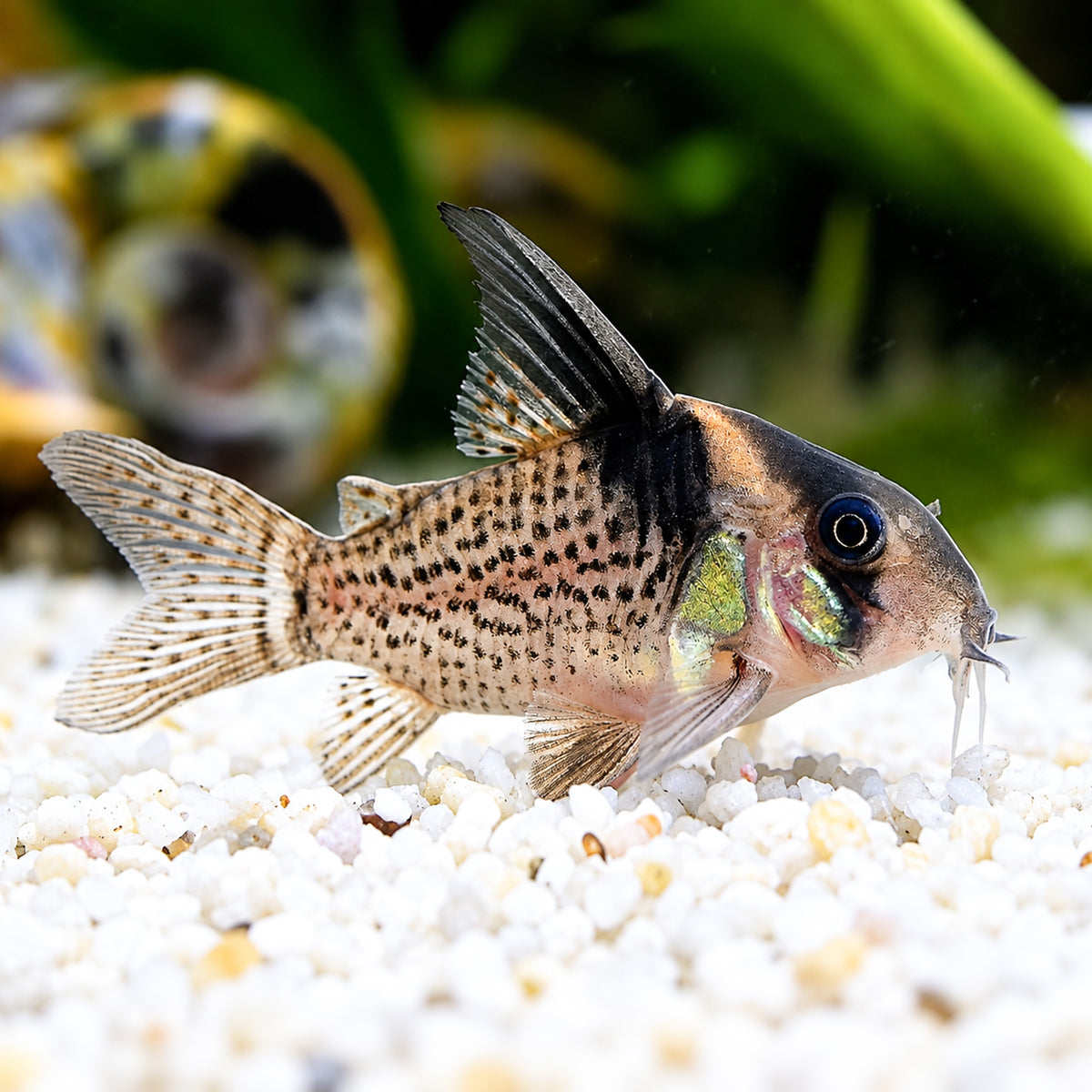
The CW027 Cory Catfish (Hoplisoma sp. CW027) is a still-undescribed collector Cory from northern South America known for its very tall dorsal fin, bright pale “glowspot” behind the head, dark facial markings, and spotted body. It is also commonly sold as the CW027 Highfin Spotted Cory. Adults reach approximately 2.25–2.5 inches and should be maintained in groups of at least 6 fish in a mature aquarium with fine sand, clean well-oxygenated water, and peaceful tank mates.
The CW027 Cory Catfish (Hoplisoma sp. CW027) is a distinctive short-snouted Cory-type catfish valued by collectors for its combination of spotted patterning, unusually tall dorsal fin, and bright marking across the nape.
Also known as the CW027 Highfin Cory, Highfin Spotted Cory, CW27 Cory, and historically associated with the code C154, this fish remains scientifically undescribed.
Its light gray, beige, or silver body develops numerous dark spots, while darker markings across the face and dorsal region create a strong contrast. Mature specimens can develop a remarkably tall dorsal fin, producing a much more dramatic silhouette than many common Cory species.
Another important feature is the pale area immediately behind the head. Specialist importers have described this as a bright “glowspot” on the nape, which can become especially noticeable in healthy, settled adults.
Taxonomy note: CW027 was traditionally listed as Corydoras sp. CW027. Following the 2024 revision of Corydoradinae, this Lineage 9 short-snouted fish is placed in the genus Hoplisoma. Because it has not yet received a formal species description, the appropriate current designation is Hoplisoma sp. CW027.
CW027 Cory Catfish Care Information
| Care Requirement | CW027 Cory Information |
|---|---|
| Common Name | CW027 Cory, Highfin Spotted Cory, CW027 Highfin Cory |
| Scientific / Hobby Name | Hoplisoma sp. CW027 |
| Former Hobby Name | Corydoras sp. CW027 |
| CW Number | CW027 / CW27 |
| Related Hobby Code | C154 — commonly regarded as the same taxon / younger stage |
| Species Status | Undescribed Collector Species |
| Adult Size | Males ~2.25 inches; Females up to ~2.5 inches |
| Temperature | 73–81°F (23–27°C) |
| pH Range | 6.0–7.2 |
| Water Preference | Soft to Moderately Hard; Clean, Well-Oxygenated Water |
| Recommended Tank Size | 20–30+ Gallons Recommended |
| Recommended Group Size | 6+ Recommended |
| Temperament | Peaceful & Social |
| Diet | Omnivore / Benthic Forager |
| Tank Level | Bottom Dweller |
| Care Level | Beginner to Intermediate |
| Origin | Northern South America — Colombian / Orinoco-Region Trade Records |
What Does a CW027 Cory Catfish Look Like?
The CW027 Cory Catfish has a relatively compact, short-snouted body with a pale silver-gray, cream, beige, or lightly olive base color.
Dark markings run through or around the face, while numerous black or dark brown spots cover much of the body. Additional darker pigmentation can occur around the dorsal-fin region.
The tail may also display darker striping or spotted banding, contributing to the overall highly patterned appearance.
What makes CW027 especially distinctive, however, is the combination of its high dorsal fin and bright nape marking. Mature specimens can develop an exceptionally tall dorsal fin that rises well above the normal body profile.
Why Is CW027 Called the Highfin Spotted Cory?
The common name Highfin Spotted Cory describes the two most obvious characteristics of adult CW027.
First, the body is decorated with numerous dark spots and markings. Second, adult fish can develop an unusually tall dorsal fin that is noticeably higher than the dorsal fin of many similar short-snouted Cory species.
When a mature CW027 fully raises its dorsal fin, the fish takes on a distinctive high-backed silhouette that can become one of the main visual features of a group.
Look for the combination of a very tall dorsal fin, bright nape “glowspot,” dark facial markings, and numerous body spots. These features help separate mature CW027 from several similar spotted Hoplisoma species.
What Is the CW027 Glowspot?
Specialist aquarium importers use the term “glowspot” for the bright pale marking located on the nape immediately behind the head.
This lighter area contrasts strongly with the darker head, dorsal region, and spotted body.
Aquarium Glaser has specifically noted that the CW027 glowspot is much brighter than that of typical Hoplisoma brevirostre-type fish, making it one of the most useful visual identification features.
The contrast can become more obvious as the fish matures and settles into stable aquarium conditions.
CW027 vs. Hoplisoma Brevirostre
CW027 has long been compared with Hoplisoma brevirostre because the two have a generally similar spotted color pattern.
However, aquarium specialists have identified two particularly noticeable differences.
CW027 develops a substantially taller dorsal fin and typically has a much more strongly expressed pale glowspot behind the head.
Until CW027 receives a formal scientific description, it should therefore continue to be identified by its CW027 collector number rather than being automatically labeled Hoplisoma brevirostre.
Is C154 the Same as CW027?
Specialist Cory references currently associate C154 with CW027.
ScotCat notes that C154 is considered to represent the semi-adult or younger stage of CW027, and its identification listings connect the two codes.
Because CW027 remains scientifically undescribed, it is best to keep the collector designation visible when listing or breeding these fish.
Aquarium labels may therefore appear as CW027, C154, or CW027/C154.
Is CW027 the Same as Wotroi Cory?
Some aquarium retailers use the trade name “Wotroi Cory” for CW027, but this can create taxonomic confusion.
The formally described species Hoplisoma wotroi is associated with the Saramacca River system of Suriname.
CW027, by contrast, is maintained as a separate undescribed Hoplisoma sp. CW027 in specialist Cory databases and has been commercially imported from Colombia.
For accurate product identification, the names CW027 Cory or CW027 Highfin Spotted Cory are therefore preferable to simply calling this fish Wotroi Cory.
What Does CW027 Mean?
CW027, often shortened to CW27, is the Corydoras World identification number assigned to this still-undescribed Corydoradinae catfish.
CW numbers allow aquarists, breeders, importers, and researchers to consistently identify distinctive populations before they receive formal scientific species descriptions.
This is especially important for CW027 because it belongs to a group containing several visually similar spotted Hoplisoma.
Why Is CW027 Now Hoplisoma sp. CW027?
CW027 was historically listed as Corydoras sp. CW027.
Modern phylogenetic research demonstrated that the traditional broad genus Corydoras contained several different evolutionary lineages.
The major 2024 revision of Corydoradinae placed the large short-snouted Lineage 9 group in the resurrected genus Hoplisoma.
Corydoras World now lists this fish as Hoplisoma sp. CW027.
Because CW027 is still undescribed, no formal species epithet should be added until a scientific description establishes one.
Where Do CW027 Cory Catfish Come From?
Current specialist records place CW027 in northern South America.
ScotCat lists the fish from Colombia, and Aquarium Glaser documented commercial imports of CW027 from Colombia in 2022.
Older hobby literature has also associated CW027/C154 material with the broader Orinoco region, including Venezuelan material. Because this fish remains undescribed and detailed locality information has not always accompanied aquarium imports, a highly specific single river locality should not be assumed without collection data.
Preserving importer or breeder locality information is especially valuable for collectors working with CW027.
CW027 Cory Behavior & Group Size
CW027 Corys are peaceful, social bottom-dwelling fish and should not be maintained individually.
Keep at least 6 CW027 Cory Catfish together. Groups of eight or more can be even more impressive when aquarium space and availability allow.
A comfortable group will spend much of its time searching over the substrate, resting together around wood or plants, and moving across open sections of the aquarium.
Like other Corydoradinae catfish, CW027 may occasionally make a quick trip to the surface to gulp atmospheric air before returning to the bottom. Occasional surface visits are normal behavior.
Ideal Aquarium Setup for CW027 Cory Catfish
A 20–30 gallon or larger freshwater aquarium provides a practical starting point for a group of six or more CW027.
Horizontal bottom area is more valuable than excessive tank height because the group spends much of its time exploring and foraging along the substrate.
A fine sand substrate is strongly recommended. Smooth fine gravel may also be used when kept exceptionally clean, but sharp or abrasive material should be avoided.
Driftwood, smooth rocks, roots, live plants, floating plants, and dried leaves can provide shaded cover while leaving open sandy sections for group foraging.
Moderate water movement and good surface agitation help provide the clean, oxygen-rich conditions preferred by active Cory-type catfish.
CW027 Cory Water Parameters
Specialist references provide somewhat different temperature ranges for CW027 depending on source and collection history.
A practical aquarium range is approximately 73–81°F (23–27°C), with many imported fish doing particularly well in the upper portion of that range.
A pH around 6.0–7.2 is suitable for general maintenance.
More important than chasing one exact temperature or pH value is providing clean, stable, well-oxygenated water.
Keep CW027 in a fully cycled aquarium with effective biological filtration and regular partial water changes. Ammonia and nitrite should remain at zero.
What Do CW027 Cory Catfish Eat?
CW027 Cory Catfish are omnivorous benthic foragers and readily accept a varied aquarium diet.
Good staple and supplemental foods include:
- High-quality sinking Cory pellets
- Bottom-feeder tablets or granules
- Bloodworms
- Blackworms
- Brine shrimp
- Daphnia
- Tubifex
- Other appropriately sized frozen or live foods
Make sure enough food reaches the substrate for every member of the group, especially when CW027 is housed with fast-feeding midwater fish.
CW027 Cory Catfish Tank Mates
The peaceful temperament of Hoplisoma sp. CW027 makes it suitable for many freshwater community aquariums.
Potential tank mates include peaceful tetras, rasboras, pencilfish, danios, small gouramis, peaceful dwarf cichlids, and other non-aggressive freshwater species with compatible temperature requirements.
Other peaceful Cory-type catfish may also be compatible, but they do not replace the need for a proper social group of CW027 themselves.
Avoid large predatory fish, highly territorial bottom dwellers, and aggressive species that may intimidate or injure them.
Male vs. Female CW027 Cory Catfish
Mature CW027 become easier to sex once they reach adult size.
Adult males generally remain slimmer and reach approximately 2.25 inches.
Adult females can reach approximately 2.5 inches and become noticeably broader through the abdomen, especially when viewed from above.
Juveniles can be difficult to sex reliably, so mature body shape is generally more useful than coloration alone.
Why Choose CW027 Cory Catfish?
- Exceptionally tall highfin dorsal profile
- Bright contrasting nape “glowspot”
- Attractive dark spotted body pattern
- Strong facial and dorsal-region markings
- Historic CW027 / CW27 collector identification
- Closely associated with the C154 hobby code
- Peaceful social temperament
- Still-undescribed specialty Hoplisoma species
- Excellent choice for Cory and Hoplisoma collectors
Before Buying CW027 Cory Catfish
CW027 Corys are social fish and should not be kept alone. Plan to keep at least 6 fish and introduce them only to a mature, fully cycled aquarium. Provide fine sand, clean well-oxygenated water, peaceful tank mates, natural cover, and a varied diet. Because CW027 remains scientifically undescribed, preserve the CW027 identification and any available locality or breeder information, especially if you plan to breed the fish.
CW027 Cory Catfish FAQ
What is a CW027 Cory Catfish?
CW027 is a still-undescribed short-snouted Cory-type catfish from northern South America. It is known for its spotted body, dark facial markings, bright nape spot, and unusually tall dorsal fin. Its modern hobby designation is Hoplisoma sp. CW027.
Is CW027 now Hoplisoma sp. CW027?
Yes. It was historically listed as Corydoras sp. CW027. Following the 2024 revision of Corydoradinae, its Lineage 9 group is placed in the genus Hoplisoma, making Hoplisoma sp. CW027 the appropriate modern designation.
What does CW027 mean?
CW027 is the Corydoras World identification number assigned to this scientifically undescribed fish. The number allows breeders, importers, and aquarists to consistently identify the taxon until a formal species description is published.
Why is CW027 called the Highfin Spotted Cory?
Mature CW027 can develop an exceptionally tall dorsal fin while the body carries numerous dark spots. These two characteristics inspired the Highfin Spotted Cory trade name.
What is the bright spot behind the head of CW027?
Specialist importers describe this pale nape marking as a “glowspot.” CW027 can develop a particularly bright glowspot, which helps distinguish it from similar brevirostre-type Corys.
Is C154 the same as CW027?
Current specialist Cory references commonly connect C154 with CW027. C154 has been interpreted as representing a semi-adult or younger stage of the same taxon. Because the fish remains undescribed, the CW027 designation should still be preserved.
Is CW027 the same as Hoplisoma brevirostre?
CW027 strongly resembles Hoplisoma brevirostre, but specialist references continue to maintain CW027 as an undescribed taxon. CW027 is especially noted for its much taller dorsal fin and brighter nape glowspot.
Is CW027 the same as Wotroi Cory?
Some aquarium sellers use “Wotroi Cory” for CW027, but true Hoplisoma wotroi is a formally named fish from the Saramacca River system of Suriname. For accurate identification, CW027 is better listed as Hoplisoma sp. CW027.
How big do CW027 Cory Catfish get?
Specialist references report approximately 2.25 inches for mature males and up to around 2.5 inches for females.
How many CW027 Corys should be kept together?
Keep at least 6 CW027 Cory Catfish together. They are social fish and generally display more confident, natural behavior when maintained in a proper group.
What temperature is best for CW027 Cory Catfish?
A practical aquarium range is approximately 73–81°F (23–27°C), with pH around 6.0–7.2. Stable, clean, oxygen-rich water is more important than constantly adjusting parameters.
Where do CW027 Cory Catfish come from?
Specialist databases list CW027 from northern South America, particularly Colombia, and Aquarium Glaser has documented imports from Colombia. Older aquarium literature has also associated CW027/C154 material with the broader Orinoco region.
Are CW027 Cory Catfish peaceful?
Yes. CW027 is a peaceful social catfish suitable for community aquariums containing calm tetras, rasboras, danios, pencilfish, and other non-aggressive species with compatible care requirements.
What do CW027 Cory Catfish eat?
CW027 are omnivorous foragers. Feed quality sinking pellets, tablets, or granules supplemented with frozen or live foods such as bloodworms, blackworms, brine shrimp, daphnia, and Tubifex.
Do CW027 Corys clean the aquarium?
CW027 naturally forage along the aquarium floor, but they should not be treated as aquarium maintenance animals. They require intentional feeding, regular water changes, substrate cleaning, and normal aquarium maintenance.
CW027 Cory Catfish at Tropicflow Aquatic
Add a distinctive highfin collector Cory to your freshwater aquarium with the CW027 Cory Catfish. With its unusually tall dorsal fin, bright nape glowspot, attractive spotted pattern, peaceful social behavior, and still-undescribed collector status, Hoplisoma sp. CW027 is an exceptional choice for Cory enthusiasts, planted aquariums, and carefully maintained freshwater community tanks.

Customer Review


