



CW023 Red Laser Cory Catfish – Corydoras sp. CW023
CW023 Red Laser Cory Catfish – Corydoras sp. CW023
Couldn't load pickup availability
Quick Care
Essential care information at a glance
What Fish Will I Receive?
What Fish Will I Receive?
Photos represent the species and typical appearance of the fish you will receive. Because Corydoras are living animals, individual size, coloration, markings, and pattern may vary naturally from fish to fish.
Healthy, Active Corydoras
Healthy, Active Corydoras
Every Corydoras offered by Tropicflow Aquatic is selected for healthy body condition, active behavior, clear eyes, intact barbels and fins, and normal swimming behavior before shipping.
Best Substrate for Corydoras
Best Substrate for Corydoras
Fine sand or another smooth, non-abrasive substrate is recommended. Corydoras spend much of their time searching through the substrate with their sensitive barbels.
Acclimation Directions
Acclimation Directions
1 — Open & Inspect
Check your fish immediately after delivery.
2 — Temperature Acclimation
Float the closed bag for approximately 15–20 minutes.
3 — Gradually Introduce Tank Water
Slowly add small amounts of aquarium water.
4 — Transfer the Fish
Gently move the Cory into the aquarium without pouring shipping water into the tank.
Keep aquarium lights low during the first several hours and allow the fish time to settle.
Flat Rate Shipping As Low As $25
Flat Rate Shipping As Low As $25
At Tropicflow, we strive to make the shipping process as affordable and convenient as possible for our customers. Our flat rate shipping starts as low as $25, and the more fish you purchase, the more you save on shipping fees. We encourage our customers to combine as many fish as possible in each order to take advantage of these cost-saving opportunities.
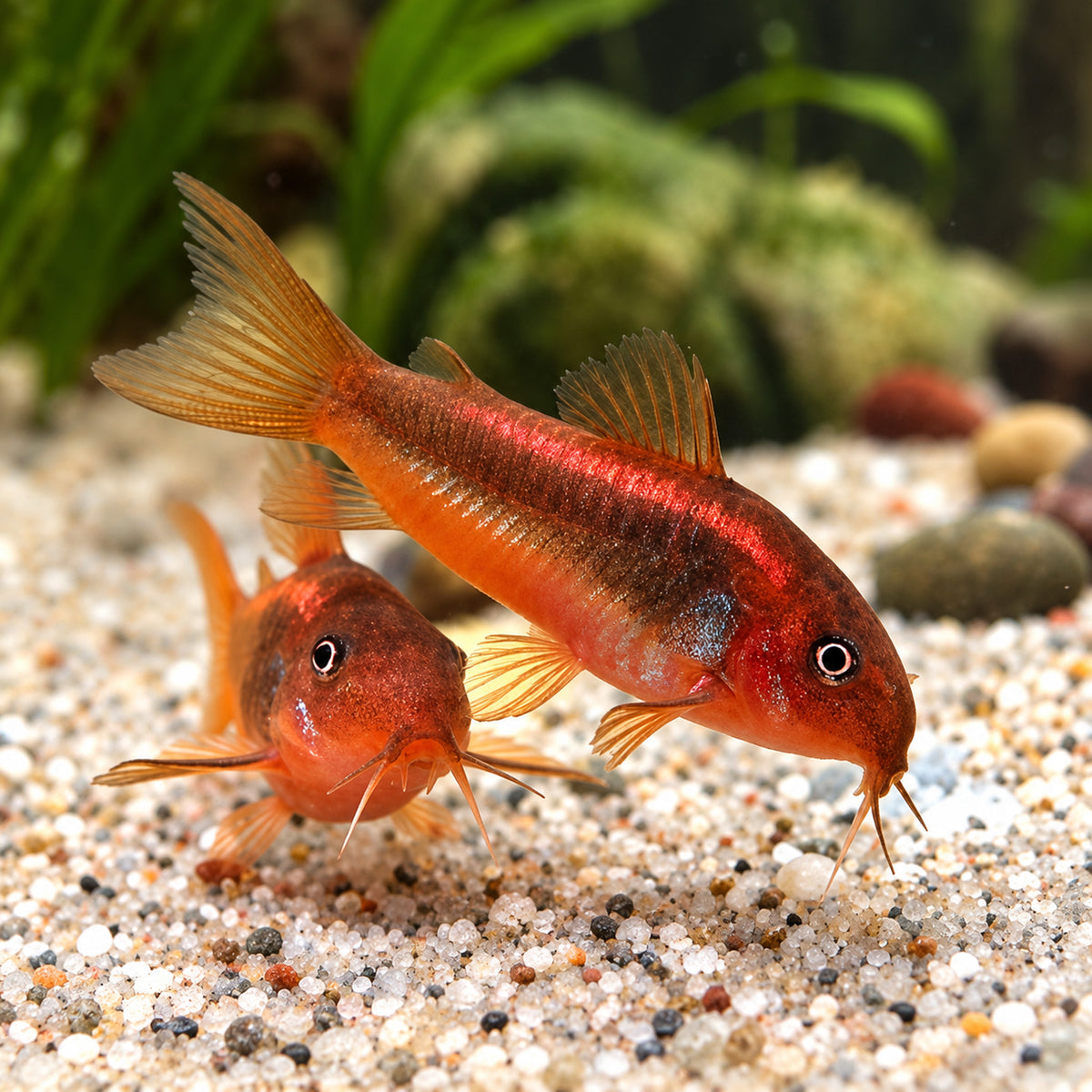
The CW023 Red Laser Cory Catfish (Corydoras sp. CW023) is a rare and exotic aquarium Cory prized for its intense red-orange metallic stripe, warm bronze body tones, and peaceful schooling behavior. This striking Red Laser form was developed from the CW023 Orange Stripe Cory line through selective breeding. Growing to around 2–2.5 inches, CW023 Red Laser Corys are best kept in groups of 6 or more, with larger groups preferred, in a mature freshwater aquarium with soft substrate and peaceful tank mates.
The CW023 Red Laser Cory Catfish (Corydoras sp. CW023) is an eye-catching collector Cory known for the brilliant red-to-orange metallic stripe running along the upper portion of its body. Combined with warm bronze, copper, and reddish body pigmentation, this laser-like stripe creates a dramatic appearance rarely seen among more traditional Cory catfish.
Also known as the Red Laser Cory, CW023 Cory, or CW023 Red Laser Corydoras, this exotic freshwater catfish combines premium coloration with the peaceful, social bottom-dwelling personality Cory keepers love.
The Red Laser form has an especially interesting aquarium history. The intense red form was selectively developed from CW023 Orange Stripe Corys after unusually red offspring appeared within captive-bred groups. Those fish were selectively bred to strengthen and stabilize the red coloration seen in today's CW023 Red Laser Cory.
Taxonomy note: CW023 is an undescribed Cory-type catfish identified by its CW number rather than a formally described species name. It has traditionally been listed as Corydoras sp. CW023. Under newer Corydoradinae classification, this lineage is placed within Osteogaster, so the fish may also be referenced as Osteogaster sp. CW023.
CW023 Red Laser Cory Catfish Care Information
| Care Requirement | CW023 Red Laser Cory Information |
|---|---|
| Common Name | CW023 Red Laser Cory, Red Laser Cory Catfish |
| Scientific / Trade Name | Corydoras sp. CW023 |
| Modern Genus Placement | Osteogaster sp. CW023 |
| Variant | Red Laser / Selectively Bred CW023 Color Form |
| Adult Size | Approximately 2–2.5 inches |
| Temperature | 72–81°F (22–27°C) |
| pH Range | 5.5–7.0 |
| Minimum Tank Size | 20+ Gallons Recommended |
| Recommended Group Size | 6+ Minimum; 8–10+ Preferred |
| Temperament | Peaceful & Social |
| Diet | Omnivore |
| Tank Level | Bottom Dweller |
| Care Level | Intermediate |
| Origin | CW023 Line Originates from Peru, South America |
What Does a CW023 Red Laser Cory Look Like?
The defining feature of the CW023 Red Laser Cory is the brilliant metallic stripe running from behind the head along the upper body toward the tail. Depending on genetics, maturity, aquarium lighting, and condition, this stripe may appear fiery red, copper-red, deep orange, or metallic orange.
The body can also show stronger warm pigmentation than many other laser Corys, including bronze, copper, orange, and reddish tones. This creates a glowing appearance that becomes especially noticeable under aquarium lighting.
The combination of a bright dorsal stripe, warm body coloration, armored body plates, and active schooling behavior gives Corydoras sp. CW023 a highly distinctive look in planted freshwater aquariums.
What Makes the CW023 Red Laser Cory Rare & Exotic?
The CW023 Red Laser Cory is a specialty aquarium strain rather than one of the standard Cory species commonly available in mass-market fish stores. Its intense red coloration was developed through selective breeding from the CW023 Orange Stripe form.
Early breeding records describe unusually red individuals appearing among offspring produced from wild-origin CW023 Orange Stripe Corys. Those red individuals were separated and selectively bred, eventually producing the more consistently intense Red Laser CW023 seen in the aquarium hobby.
CW023 Red Laser Corys combine an unusual collector code, selective-bred color, and brilliant metallic red-orange stripe. For Cory enthusiasts looking beyond Panda, Bronze, Sterbai, and other commonly available species, CW023 offers a distinctive addition to a specialty Cory collection.
CW023 Red Laser Cory vs. CW023 Orange Stripe Cory
Both forms trace back to CW023, but the primary difference is color intensity. Traditional CW023 Orange Stripe Corys display a metallic orange dorsal stripe, while selectively bred Red Laser individuals were developed for noticeably stronger red pigmentation.
Red Laser CW023 may display deeper red along the dorsal stripe as well as stronger reddish pigmentation across parts of the body. Color intensity can still vary naturally from fish to fish.
Genetics, age, diet, stress level, substrate, aquarium lighting, and overall condition can all influence how strongly the red and orange tones appear.
CW023 Red Laser Cory Behavior & Group Size
Red Laser Corys are peaceful, social bottom-dwelling fish and should not be kept alone. We recommend keeping at least 6 CW023 Red Laser Cory Catfish together, with 8–10 or more preferred when aquarium size and filtration allow.
In a proper group, they can often be seen exploring the substrate together, searching for food, resting near one another, and moving around the lower portion of the aquarium as a loose school.
Larger groups can help encourage more confident and natural social behavior while also creating an impressive display of metallic red-orange stripes moving together across the aquarium floor.
Like other Cory-type catfish, CW023 may occasionally make a quick trip to the water surface to gulp atmospheric air before returning to the bottom. Occasional surface visits are normal Cory behavior.
Ideal Aquarium Setup for CW023 Red Laser Corys
A 20-gallon or larger freshwater aquarium provides a practical starting point for a proper school of Red Laser Corys. Horizontal bottom space is particularly important because these fish spend much of their time exploring and foraging along the substrate.
A fine sand substrate or smooth rounded fine gravel is recommended. CW023 Red Laser Corys use sensitive barbels around their mouths while searching for food, so sharp or abrasive substrate should be avoided.
Live plants, driftwood, smooth rocks, shaded areas, leaf litter, and open sections of substrate can create an attractive natural-style environment while providing plenty of space for the group to forage.
CW023 Red Laser Cory Water Parameters
CW023 Red Laser Cory Catfish can generally be maintained at temperatures around 72–81°F (22–27°C) with a pH of approximately 5.5–7.0.
Stable water quality is more important than constantly adjusting the aquarium to reach one exact number. Keep Red Laser Corys in a fully cycled aquarium with appropriate filtration, good oxygenation, and regular water changes.
Ammonia and nitrite should remain at zero, and sudden changes in temperature or water chemistry should be avoided. Keeping the substrate clean is also important because Cory catfish spend significant amounts of time in direct contact with the aquarium floor.
What Do CW023 Red Laser Cory Catfish Eat?
CW023 Red Laser Corys are omnivorous foragers and should receive a varied, nutritious diet. High-quality sinking pellets, tablets, or wafers can form the foundation of their aquarium diet.
Their diet can also be supplemented with appropriately sized frozen or live foods such as bloodworms, brine shrimp, daphnia, Tubifex, and other suitable foods.
A varied diet and stable aquarium environment can help fish maintain healthy body condition and display their natural metallic coloration.
CW023 Red Laser Cory Tank Mates
The peaceful temperament of the CW023 Red Laser Cory Catfish makes it suitable for many freshwater community aquariums. Tank mates should be peaceful and comfortable within similar temperature and water conditions.
Potential tank mates may include peaceful tetras, rasboras, danios, small peaceful livebearers, peaceful gouramis, compatible dwarf cichlids, other suitable Cory-type catfish, and other non-aggressive freshwater species.
Avoid large predatory fish and aggressive tank mates that may chase, injure, intimidate, or prevent the Red Laser Corys from feeding comfortably.
Why Choose CW023 Red Laser Cory Catfish?
- Brilliant metallic red-to-orange laser stripe
- Rare specialty Cory for collectors
- Exotic alternative to commonly available Cory species
- Warm bronze, copper, and reddish body coloration
- Peaceful temperament for community aquariums
- Active and entertaining bottom-dwelling behavior
- Excellent choice for planted freshwater aquariums
- Social schooling behavior when maintained in a proper group
Before Buying CW023 Red Laser Cory Catfish
CW023 Red Laser Corys are social fish and should not be kept alone. Plan to keep at least 6 fish, with larger groups preferred whenever aquarium space and filtration allow. Make sure the aquarium is fully cycled and provide soft substrate, peaceful tank mates, stable water conditions, a clean aquarium floor, and enough horizontal space for the group to comfortably explore and forage.
CW023 Red Laser Cory Catfish FAQ
What is a CW023 Red Laser Cory Catfish?
The CW023 Red Laser Cory is a selectively developed color form of the undescribed Cory-type catfish identified by the aquarium code CW023. It is known for its metallic red-to-orange dorsal stripe and warm bronze and reddish body coloration.
What does CW023 mean?
CW023 is a catalog-style identification number used in the Corydoras hobby for a distinct fish that has not yet received a formal species description. These CW numbers help aquarists distinguish undescribed Cory forms before an official scientific name is assigned.
Is the CW023 Red Laser Cory rare?
CW023 Red Laser Corys are considered a specialty collector fish in the aquarium hobby and are generally less commonly available than standard Corys such as Bronze, Panda, or Peppered Corys. Availability can vary depending on breeder production and imports.
Is the Red Laser CW023 naturally red?
The intense Red Laser form was developed through selective breeding. Breeders identified unusually red offspring produced from CW023 Orange Stripe stock and selectively bred those fish to establish stronger red coloration in subsequent generations.
How big do CW023 Red Laser Cory Catfish get?
Adult CW023 Red Laser Corys generally reach approximately 2–2.5 inches, or around 6 cm, making them a manageable size for many peaceful freshwater community aquariums.
How many Red Laser Corys should be kept together?
Keep CW023 Red Laser Corys in a group of at least 6 fish. When aquarium size and filtration allow, groups of 8–10 or more are preferred for stronger schooling and more natural social behavior.
What temperature is best for CW023 Red Laser Corys?
A general aquarium temperature range for CW023 Red Laser Corys is approximately 72–81°F (22–27°C). Tank mates should have compatible temperature and water requirements.
Are CW023 Red Laser Cory Catfish peaceful?
Yes. CW023 Red Laser Corys are peaceful, social fish and can work well in freshwater community aquariums containing other non-aggressive species with compatible care requirements.
Is Corydoras sp. CW023 now Osteogaster sp. CW023?
CW023 has traditionally been listed as Corydoras sp. CW023. Following newer classification of the Corydoradinae, this lineage is placed within Osteogaster, so modern references may list the fish as Osteogaster sp. CW023. The familiar Corydoras CW023 name remains widely used in the aquarium trade.
Do CW023 Red Laser Corys clean the aquarium?
Red Laser Corys naturally forage along the aquarium floor for food, but they should not be considered a replacement for aquarium maintenance. They require their own nutritious sinking foods along with regular water changes and substrate cleaning.
CW023 Red Laser Cory Catfish at Tropicflow Aquatic
Add a rare collector Cory with exceptional color to your freshwater aquarium with the CW023 Red Laser Cory Catfish. With its brilliant metallic red-orange stripe, warm bronze coloration, peaceful personality, and active schooling behavior, Corydoras sp. CW023 is an exotic choice for Cory enthusiasts, planted aquariums, and carefully planned freshwater community tanks.


Customer Review


