



Ceara Bulldog Cory Catfish – Aspidoras Raimundi
Ceara Bulldog Cory Catfish – Aspidoras Raimundi
Couldn't load pickup availability
Quick Care
Essential care information at a glance
What Fish Will I Receive?
What Fish Will I Receive?
Photos represent the species and typical appearance of the fish you will receive. Because Corydoras are living animals, individual size, coloration, markings, and pattern may vary naturally from fish to fish.
Healthy, Active Corydoras
Healthy, Active Corydoras
Every Corydoras offered by Tropicflow Aquatic is selected for healthy body condition, active behavior, clear eyes, intact barbels and fins, and normal swimming behavior before shipping.
Best Substrate for Corydoras
Best Substrate for Corydoras
Fine sand or another smooth, non-abrasive substrate is recommended. Corydoras spend much of their time searching through the substrate with their sensitive barbels.
Acclimation Directions
Acclimation Directions
1 — Open & Inspect
Check your fish immediately after delivery.
2 — Temperature Acclimation
Float the closed bag for approximately 15–20 minutes.
3 — Gradually Introduce Tank Water
Slowly add small amounts of aquarium water.
4 — Transfer the Fish
Gently move the Cory into the aquarium without pouring shipping water into the tank.
Keep aquarium lights low during the first several hours and allow the fish time to settle.
Flat Rate Shipping As Low As $25
Flat Rate Shipping As Low As $25
At Tropicflow, we strive to make the shipping process as affordable and convenient as possible for our customers. Our flat rate shipping starts as low as $25, and the more fish you purchase, the more you save on shipping fees. We encourage our customers to combine as many fish as possible in each order to take advantage of these cost-saving opportunities.
The Ceara Bulldog Cory Catfish (Aspidoras raimundi) is a small, energetic Brazilian armored catfish known for its compact “bulldog” profile, variable dark spotting, dorsal-fin markings, and subtle yellow-green iridescence. Unlike many familiar Corydoras, this fish belongs to the separate genus Aspidoras. Adults generally remain around 1.3–1.7 inches and should be maintained in groups of at least 6 fish. A mature aquarium with fine sand, clean oxygen-rich water, cover, and peaceful tank mates is recommended.
The Ceara Bulldog Cory Catfish (Aspidoras raimundi) is a small South American armored catfish with the familiar social personality of a Cory but a distinctly compact Aspidoras body shape.
Also known as the Ceara Bulldog Cory, Raimundi Aspidoras, or Aspidoras raimundi, this species occurs across several river systems of northern and northeastern Brazil.
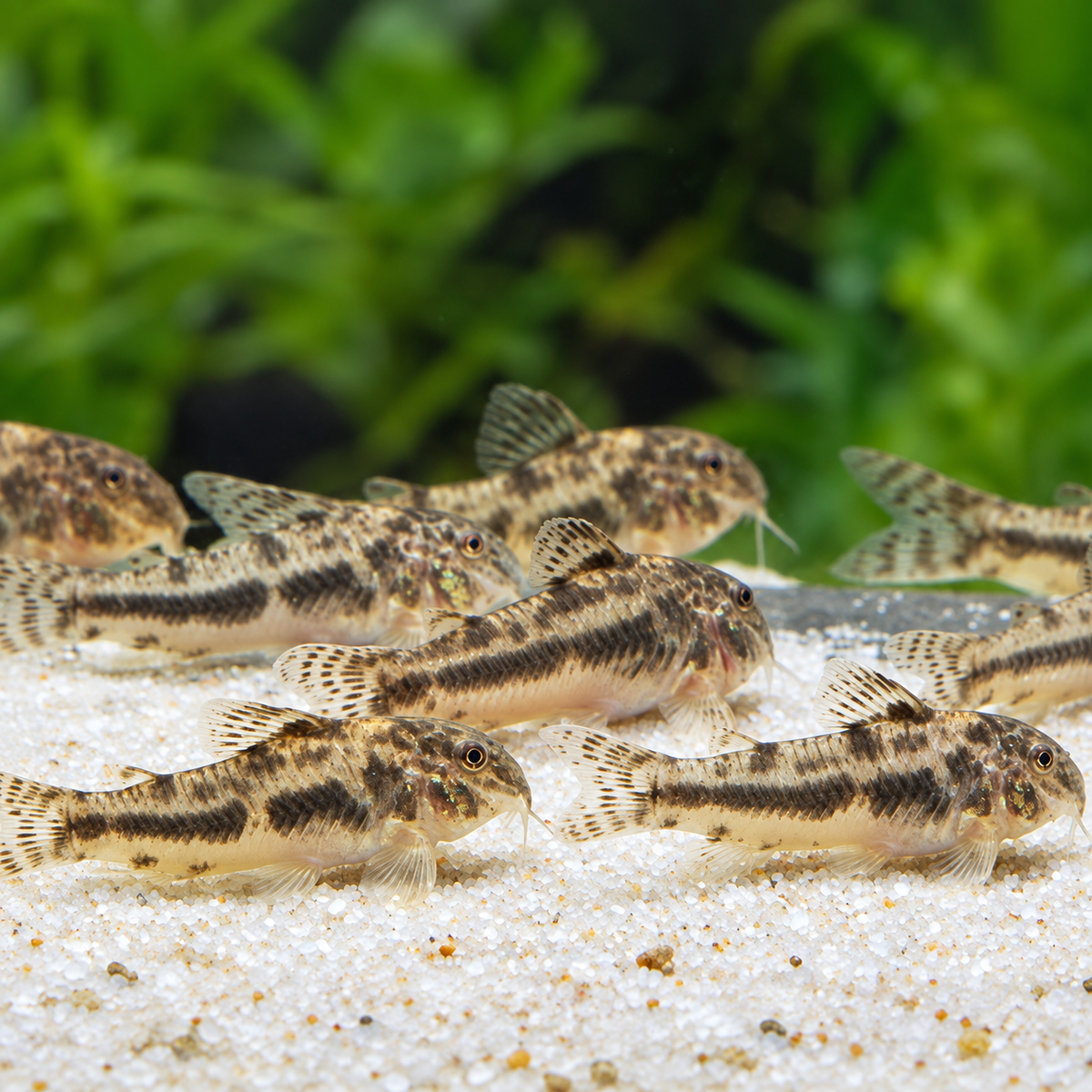
Color and pattern can vary considerably between populations. Fish may display a pale gray, yellowish, beige, or lightly olive body covered with irregular dark spots and blotches. Some individuals develop larger markings along the midline that partially connect into a broken horizontal stripe.
Healthy fish can also show subtle whitish-yellow and green iridescent highlights, especially under aquarium lighting.
Taxonomy note: Aspidoras raimundi remains the currently accepted scientific name. A major 2022 revision of the genus found that several previously recognized Aspidoras—including Aspidoras menezesi and Aspidoras spilotus—fall within the natural variation of Aspidoras raimundi and are now treated as junior synonyms of this species.
Ceara Bulldog Cory Catfish Care Information
| Care Requirement | Ceara Bulldog Cory Information |
|---|---|
| Common Name | Ceara Bulldog Cory, Bulldog Cory, Raimundi Aspidoras |
| Scientific Name | Aspidoras raimundi |
| Known Junior Synonyms | Aspidoras menezesi, Aspidoras spilotus |
| Adult Size | Approximately 1.3–1.7 inches |
| Temperature | 68–77°F (20–25°C) |
| pH Range | 6.0–7.5 |
| Water Hardness | Soft to Moderately Hard |
| Recommended Tank Size | 15–20+ Gallons Recommended |
| Recommended Group Size | 6+ Recommended |
| Temperament | Peaceful, Active & Social |
| Diet | Omnivore / Micro-Forager |
| Tank Level | Bottom to Lower Levels |
| Care Level | Beginner to Intermediate |
| Origin | North & Northeastern Brazil |
What Does a Ceara Bulldog Cory Catfish Look Like?
The Ceara Bulldog Cory is a small armored catfish with a compact body and relatively broad head that gives it the distinctive “bulldog” appearance associated with many members of the Aspidoras genus.
Base coloration can range from grayish-yellow and beige to pale olive or sandy brown. The sides of the body are decorated with variable dark brown or black spots, blotches, and short elongated markings.
Some individuals display separate roundish mid-body blotches, while in others these markings become elongated and may partially fuse into a broken horizontal stripe.
The dorsal fin may show a large dark blotch, smaller spots, or a more lightly pigmented pattern depending on the individual and geographic form.
Live specimens can also show attractive yellow-white and green iridescent reflections across the body.
Why Do Ceara Bulldog Corys Have Different Patterns?
One of the most interesting characteristics of Aspidoras raimundi is its naturally high degree of color and pattern variation.
Scientific examination of populations from different Brazilian river systems found considerable variation in dorsal-fin pigmentation, mid-body blotches, stripe formation, and even snout shape.
This variation was significant enough that some populations were historically described as separate species.
Natural variation is normal in Aspidoras raimundi. One fish may have separated dark spots while another may show elongated markings forming a partial stripe. Dorsal-fin markings can also vary considerably between individuals and populations.
Aspidoras Raimundi vs. Aspidoras Menezesi & Aspidoras Spilotus
Older aquarium books and specialty fish references may list Aspidoras menezesi and Aspidoras spilotus as separate species.
However, a comprehensive scientific revision of the genus Aspidoras published in 2022 examined morphology and color patterns across a large number of specimens.
Researchers found that the characteristics previously used to separate A. menezesi and A. spilotus fall within the natural variation of Aspidoras raimundi.
Both names are therefore currently treated as junior synonyms of Aspidoras raimundi.
Are C125 and CW119 Also Aspidoras Raimundi?
Yes. The 2022 revision also concluded that aquarium fish historically identified as C125 and CW119 fit within the variable morphology and coloration of Aspidoras raimundi.
C125 was associated with the form previously called Aspidoras spilotus, while CW119 represented another population with coloration falling within the broader A. raimundi complex.
This makes Aspidoras raimundi a particularly interesting example of how aquarium trade names and coded Cory forms can change after detailed scientific revision.
Aspidoras vs. Corydoras: What Is the Difference?
Ceara Bulldog Corys belong to the genus Aspidoras, not the genus Corydoras.
Both groups belong to the family Callichthyidae and share familiar characteristics such as armored body plates, barbels, social behavior, bottom foraging, and the ability to take occasional atmospheric air at the surface.
Aspidoras are generally relatively small and often have a compact, active appearance. Despite the common aquarium name “Cory,” Aspidoras raimundi is a true Aspidoras species and should retain that scientific identification.
Where Do Ceara Bulldog Cory Catfish Come From?
Despite the common name Ceara Bulldog Cory, modern taxonomic work shows that Aspidoras raimundi has a much broader distribution than Ceará alone.
The species occurs in northern and northeastern Brazil and has been documented from the Parnaíba, São Francisco, Tocantins, Acaraú, Coreaú, and Jaguaribe river basins.
Its known range includes portions of Ceará, Maranhão, Pernambuco, Piauí, and Tocantins.
The original type locality of A. raimundi is associated with the Parnaíba River near Alto Parnaíba in Maranhão, Brazil.
Ceara Bulldog Cory Behavior & Group Size
Ceara Bulldog Corys are peaceful, active, and highly social.
Keep at least 6 Aspidoras raimundi together. Larger groups can encourage more confident activity and provide a more natural social environment.
Compared with some heavier-bodied Cory species, Aspidoras can appear particularly energetic while searching through the substrate and exploring the lower levels of the aquarium.
Like other Corydoradinae catfish, they may occasionally make a fast trip to the surface to gulp atmospheric air before returning to the lower portion of the aquarium. Occasional surface visits are normal.
Ideal Aquarium Setup for Ceara Bulldog Cory Catfish
Although the Ceara Bulldog Cory is a small fish, it is active and social. An aquarium around 15–20 gallons or larger with a footprint of approximately 24 × 12 inches or greater is recommended for a proper group.
A fine sand substrate is ideal. Smooth rounded fine gravel may also be used if kept scrupulously clean, but sharp or abrasive substrate should be avoided.
Driftwood, smooth rocks, dried leaves, live plants, and shaded areas can provide useful cover while open sand sections allow the group to forage naturally.
This species should be added only to a fully cycled and biologically mature aquarium. Stable water quality is especially important for these small armored catfish.
Ceara Bulldog Cory Water Parameters
A practical aquarium range for the Ceara Bulldog Cory is approximately 68–77°F (20–25°C) with a pH around 6.0–7.5.
Soft to moderately hard water is suitable for general maintenance. More important than chasing one exact pH or hardness value is providing clean, stable, oxygen-rich water.
Use effective biological filtration and perform regular water changes. Ammonia and nitrite should remain at zero.
Avoid adding Ceara Bulldog Corys to newly established or biologically unstable aquariums.
What Do Ceara Bulldog Cory Catfish Eat?
Aspidoras raimundi are omnivorous micro-foragers and should receive a varied diet consisting of appropriately sized foods.
Good aquarium foods can include:
- Small sinking pellets
- Fine bottom-feeder tablets
- Frozen or live bloodworms
- Small Tubifex
- Brine shrimp
- Daphnia
- Other appropriately sized micro foods
Because these fish remain small, make sure food particles are appropriately sized and actually reach the group.
Ceara Bulldog Cory Tank Mates
The peaceful temperament of Aspidoras raimundi makes it suitable for carefully planned freshwater community aquariums.
Potential tank mates may include small peaceful tetras, rasboras, pencilfish, small danios, peaceful dwarf fish, other compatible Corydoradinae catfish, and similarly sized non-aggressive species.
Avoid large predatory fish, aggressive bottom dwellers, and highly competitive species that may intimidate these small Aspidoras or prevent them from receiving enough food.
Male vs. Female Ceara Bulldog Cory
Mature females generally become larger, broader, and rounder through the abdomen, particularly when viewed from above.
Adult males usually remain slimmer and somewhat more streamlined.
Sex differences become easier to recognize once fish are fully mature and maintained in good body condition.
Why Choose Ceara Bulldog Cory Catfish?
- Compact bulldog-like Aspidoras appearance
- Highly variable natural spotting and blotching
- Subtle yellow-green iridescent coloration
- Small adult size for planted community aquariums
- Peaceful and highly social behavior
- Active bottom-foraging personality
- Interesting alternative to traditional Corydoras species
- Scientifically important species with several former synonyms
- Excellent choice for Aspidoras and Corydoradinae enthusiasts
Before Buying Ceara Bulldog Cory Catfish
Ceara Bulldog Corys are social fish and should not be kept alone. Plan to keep 6 or more and introduce them only to a mature, fully cycled aquarium. Provide fine sand, clean stable water, good oxygenation, peaceful tank mates, natural cover, and appropriately sized foods. Expect natural differences in pattern because Aspidoras raimundi is a particularly variable species.
Ceara Bulldog Cory Catfish FAQ
What is a Ceara Bulldog Cory Catfish?
The Ceara Bulldog Cory is a small Brazilian armored catfish scientifically known as Aspidoras raimundi. It is known for its compact body, variable dark spotting and blotching, peaceful behavior, and active social personality.
Is Aspidoras raimundi actually a Corydoras?
No. It belongs to the separate genus Aspidoras, although Aspidoras and Corydoras are closely related members of the armored catfish subfamily Corydoradinae and share many similar aquarium behaviors.
Is Aspidoras menezesi the same as Aspidoras raimundi?
Yes. A comprehensive 2022 taxonomic revision concluded that the characteristics of Aspidoras menezesi fall within the natural variation of Aspidoras raimundi. It is now treated as a junior synonym of A. raimundi.
Is Aspidoras spilotus the same as Aspidoras raimundi?
Yes. The same 2022 revision also synonymized Aspidoras spilotus with Aspidoras raimundi after finding that its morphology and coloration fall within the normal variation of the species.
Are C125 and CW119 Aspidoras raimundi?
Current taxonomic research indicates that the aquarium forms known as C125 and CW119 fit within the morphological and color variation of Aspidoras raimundi.
How big do Ceara Bulldog Cory Catfish get?
FishBase records typical Aspidoras raimundi around 3.3 cm standard length, while populations historically described under synonymous names can exceed 4 cm. In aquarium terms, adults are generally around 1.3–1.7 inches.
How many Ceara Bulldog Corys should be kept together?
Keep at least 6 fish. Aspidoras are social and generally display more confident, active behavior when maintained with several members of their own species.
What temperature is best for Ceara Bulldog Corys?
A practical long-term aquarium range is approximately 68–77°F (20–25°C), with a pH around 6.0–7.5.
Where do Ceara Bulldog Cory Catfish come from?
Aspidoras raimundi is native to northern and northeastern Brazil. Modern records include the Parnaíba, São Francisco, Tocantins, Acaraú, Coreaú, and Jaguaribe drainage systems across Ceará, Maranhão, Pernambuco, Piauí, and Tocantins.
Why do Ceara Bulldog Corys look different from each other?
Natural pattern variation is extensive in this species. Mid-body markings may range from isolated spots to elongated blotches or a partial stripe, and dorsal-fin markings can also vary considerably.
Are Ceara Bulldog Cory Catfish peaceful?
Yes. They are peaceful, social armored catfish best kept with other small, non-aggressive freshwater species that share compatible temperature and water requirements.
What do Ceara Bulldog Cory Catfish eat?
They are omnivorous micro-foragers. Feed appropriately sized sinking pellets or tablets along with small frozen or live foods such as bloodworms, Tubifex, brine shrimp, and daphnia.
Do Ceara Bulldog Corys clean the aquarium?
They naturally forage along the aquarium floor but should not be considered aquarium maintenance animals. They require intentional feeding, regular water changes, and normal substrate cleaning.
Ceara Bulldog Cory Catfish at Tropicflow Aquatic
Add a compact and fascinating Brazilian armored catfish to your freshwater aquarium with the Ceara Bulldog Cory Catfish. With its variable spotted pattern, subtle iridescence, active social behavior, and distinctive Aspidoras profile, Aspidoras raimundi is an excellent choice for planted aquariums, peaceful community setups, and Corydoradinae enthusiasts.


Customer Review


