



C065 Guarana Cory Catfish – Corydoras Eversi
C065 Guarana Cory Catfish – Corydoras Eversi
Couldn't load pickup availability
Quick Care
Essential care information at a glance
What Fish Will I Receive?
What Fish Will I Receive?
Photos represent the species and typical appearance of the fish you will receive. Because Corydoras are living animals, individual size, coloration, markings, and pattern may vary naturally from fish to fish.
Healthy, Active Corydoras
Healthy, Active Corydoras
Every Corydoras offered by Tropicflow Aquatic is selected for healthy body condition, active behavior, clear eyes, intact barbels and fins, and normal swimming behavior before shipping.
Best Substrate for Corydoras
Best Substrate for Corydoras
Fine sand or another smooth, non-abrasive substrate is recommended. Corydoras spend much of their time searching through the substrate with their sensitive barbels.
Acclimation Directions
Acclimation Directions
1 — Open & Inspect
Check your fish immediately after delivery.
2 — Temperature Acclimation
Float the closed bag for approximately 15–20 minutes.
3 — Gradually Introduce Tank Water
Slowly add small amounts of aquarium water.
4 — Transfer the Fish
Gently move the Cory into the aquarium without pouring shipping water into the tank.
Keep aquarium lights low during the first several hours and allow the fish time to settle.
Flat Rate Shipping As Low As $25
Flat Rate Shipping As Low As $25
At Tropicflow, we strive to make the shipping process as affordable and convenient as possible for our customers. Our flat rate shipping starts as low as $25, and the more fish you purchase, the more you save on shipping fees. We encourage our customers to combine as many fish as possible in each order to take advantage of these cost-saving opportunities.
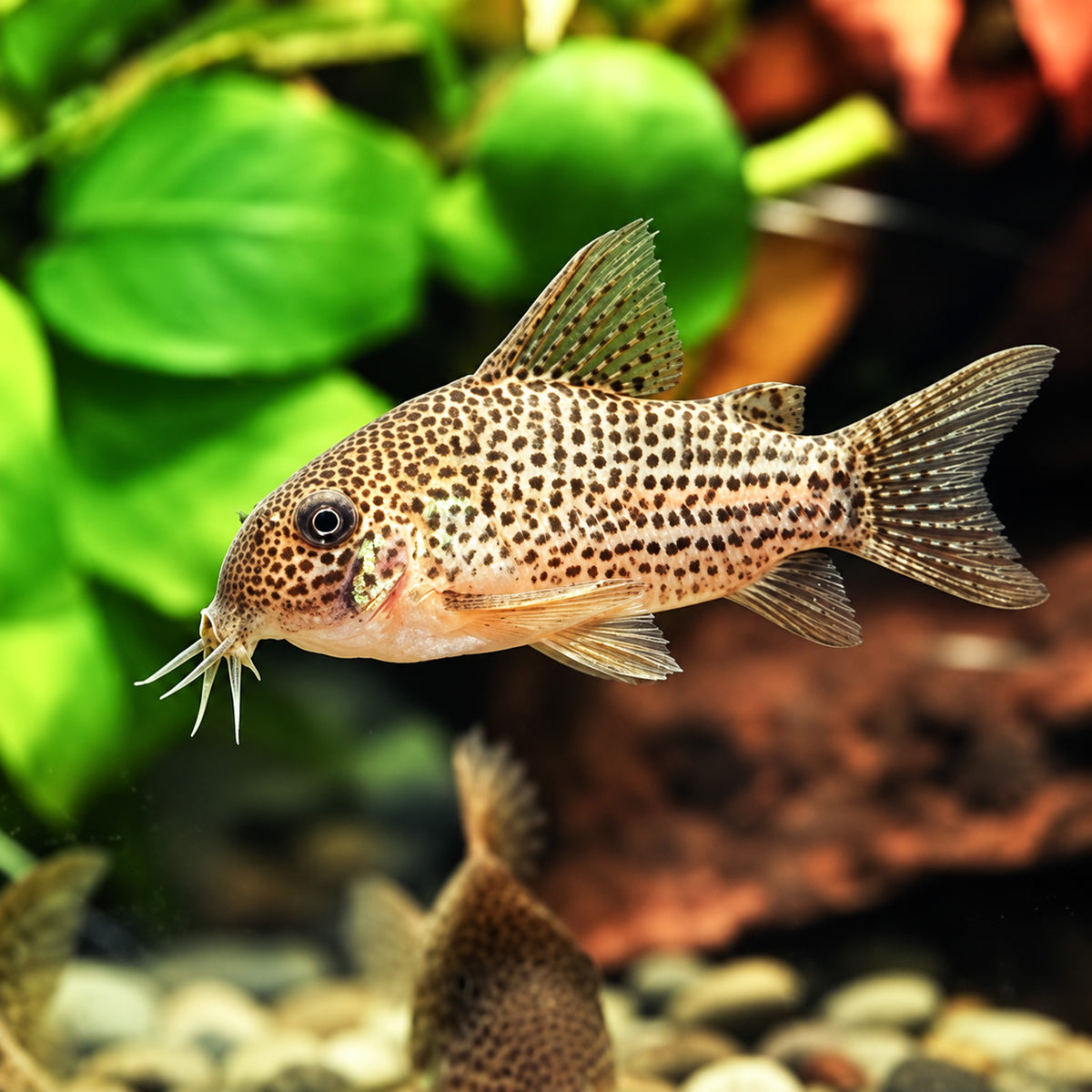
The C065 Guarana Cory Catfish (Corydoras eversi) is a distinctive Brazilian Cory known for its intense orange body, dense dark spotting, and greenish-yellow iridescent sheen. Originally known to aquarists as C65/C065 and Corydoras sp. “Guaraná”, it was formally described in 2016 and is now scientifically classified as Hoplisoma eversi. Growing to approximately 1.75–2.25 inches, this peaceful social catfish should be maintained in groups of at least 6 fish in a mature freshwater aquarium with fine sand, clean water, good oxygenation, and peaceful tank mates.
The C065 Guarana Cory Catfish (Corydoras eversi) is one of the more colorful and historically interesting Cory-type catfish in the aquarium hobby.
Its combination of bright orange coloration, numerous irregular dark spots, and metallic green-yellow iridescence gives the fish an appearance very different from many traditional silver, bronze, or black-and-white Cory species.
Before receiving a formal scientific name, this fish was widely known as Corydoras sp. C65, C065, Guarana Cory, and occasionally Soda Pop Cory.
The name “Guarana” refers to the vivid reddish-orange or orange coloration displayed by live specimens, which reminded Brazilian collectors of popular guaraná-colored beverages.
Taxonomy note: The species was formally described in 2016 as Corydoras eversi. Following the major 2024 revision of Corydoradinae, it was transferred to the genus Hoplisoma. Its current accepted scientific name is therefore Hoplisoma eversi.
C065 Guarana Cory Catfish Care Information
| Care Requirement | C065 Guarana Cory Information |
|---|---|
| Common Name | Guarana Cory, C065 Cory, C65 Cory, Soda Pop Cory |
| Traditional Scientific Name | Corydoras eversi |
| Current Scientific Name | Hoplisoma eversi |
| Former Hobby Name | Corydoras sp. “Guaraná” |
| C-Number | C065 / C65 |
| Adult Size | Males ~1.75 inches; Females up to ~2.25 inches |
| Temperature | 71–79°F (22–26°C) |
| pH Range | 6.0–7.5 |
| Water Preference | Clean, Stable, Soft to Moderately Hard Water |
| Recommended Tank Size | 20+ Gallons Recommended |
| Recommended Group Size | 6+ Recommended |
| Temperament | Peaceful & Social |
| Diet | Omnivore / Benthic Forager |
| Tank Level | Bottom Dweller |
| Care Level | Beginner to Intermediate |
| Origin | Rio Araguaia Basin, Goiás, Brazil |
What Does a C065 Guarana Cory Catfish Look Like?
The C065 Guarana Cory is a short-snouted Cory with one of the more distinctive warm color palettes in the group.
Live specimens can develop an intense orange to reddish-orange body covered with numerous irregular dark brown or black spots.
The dark markings are especially dense across the dorsal and lateral portions of the body and can align into irregular longitudinal rows or broken stripes.
A beautiful greenish-yellow iridescent sheen can overlay the orange base coloration, creating a metallic appearance under good aquarium lighting.
The fins may also contain irregular dark spotting. Tail-fin patterning can vary, with most individuals showing scattered markings rather than strong solid vertical bands.
Why Is C065 Called the Guarana Cory?
The name Guarana Cory comes directly from the bright orange or reddish-orange coloration of living specimens.
Brazilian collectors compared this intense color with the appearance of popular guaraná beverages, and the aquarium fish became known as Corydoras sp. “Guaraná” long before it received a formal scientific name.
The combination of an intense orange body, dense irregular dark spotting, and greenish-yellow iridescence makes C065 immediately recognizable among many Cory-type catfish. Newly shipped or stressed fish may temporarily display weaker coloration before settling into stable aquarium conditions.
What Does C065 Mean?
C065, commonly shortened to C65, was the aquarium hobby identification code assigned to this fish before it had a formal scientific name.
The species entered the aquarium hobby after specimens were collected in the Rio Araguaia drainage of Brazil in 1998. For many years, aquarists knew the fish primarily as Corydoras sp. C65 or Corydoras sp. “Guaraná.”
In 2016, Luiz Tencatt and Marcelo Britto formally described the species as Corydoras eversi, ending the need for a temporary coded scientific identity.
The C065 designation remains widely recognized by Cory collectors, breeders, and specialty aquarium retailers.
Why Is It Named Corydoras Eversi?
The species name eversi honors German aquarist and Cory specialist Hans-Georg Evers.
Evers collected the specimens from Brazil that ultimately formed the basis for both the aquarium population and the later scientific description of the species.
His work with Corydoradinae catfish, including collecting, identifying, breeding, and documenting species, has played an important role in the modern aquarium understanding of this group.
Is Corydoras Eversi Now Hoplisoma Eversi?
Yes. The fish was formally described in 2016 as Corydoras eversi.
Modern phylogenetic research showed that the old broad Corydoras genus contained several distinct evolutionary lineages. The major 2024 revision of Corydoradinae transferred this short-snouted lineage into the resurrected genus Hoplisoma.
The currently accepted scientific combination is therefore Hoplisoma eversi.
Because Corydoras eversi and C065 remain widely used in aquarium searches, retaining those names on a product page is useful for customer recognition while the current scientific name is also provided.
C065 Guarana Cory vs. Araguaia Cory
C065 has historically been compared with Corydoras araguaiaensis because both come from the Rio Araguaia system and share a spotted overall pattern.
Before C065 was formally described, some material was even referred to as a form related to C. araguaiaensis.
Detailed morphological examination later demonstrated that C065 represents a separate species. The formal description of Corydoras eversi identified differences in skull structure, body plating, pectoral-spine serration, and color pattern.
For aquarium identification, C065 is especially recognizable by its intense orange live coloration combined with dense irregular dark spotting.
Where Do C065 Guarana Cory Catfish Come From?
Hoplisoma eversi is known scientifically from an unnamed stream tributary of the Rio Araguaia near Montes Claros de Goiás, Goiás State, Brazil.
This locality lies within central Brazil and forms part of the larger Tocantins-Araguaia drainage system.
The species may potentially occur more widely in nearby streams, but its confirmed scientific records are centered around the original collection locality.
Because locality data for this species are relatively specific, accurate identification and breeder records are valuable for maintaining the integrity of captive populations.
C065 Guarana Cory Behavior & Group Size
Guarana Corys are peaceful, social bottom-dwelling fish and should not be kept alone.
Keep at least 6 C065 Guarana Cory Catfish together. A proper group encourages more confident activity and allows the fish to display their natural social behavior.
They can be maintained with calm community fish of similar size and temperament, provided the aquarium offers enough bottom space and food reaches the entire Cory group.
Like other Corydoradinae catfish, Guarana Corys may occasionally make a rapid trip to the surface to gulp atmospheric air before returning to the substrate. Occasional surface visits are normal behavior.
Ideal Aquarium Setup for C065 Guarana Cory Catfish
A 20-gallon long aquarium or larger provides a practical starting point for a group of six or more Guarana Corys.
Horizontal bottom space is more useful than excessive aquarium height because these fish spend much of their time exploring and searching the substrate.
A fine sand substrate is strongly recommended. Smooth fine gravel may also work if carefully maintained, but sharp or abrasive material should be avoided.
Driftwood, roots, smooth stones, dried leaves, and live plants can provide useful cover while open sections of sand allow natural group-foraging behavior.
The bright orange and metallic coloration of C065 can be especially striking against dark driftwood, green plants, and neutral-colored sand.
C065 Guarana Cory Water Parameters
A practical aquarium temperature range for the Guarana Cory is approximately 71–79°F (22–26°C).
A pH around 6.0–7.5 works well for general maintenance, provided water conditions remain stable.
More important than attempting to reach one precise number is maintaining clean, stable, well-oxygenated water.
Keep the aquarium fully cycled with effective biological filtration and regular water changes. Ammonia and nitrite should remain at zero.
Consistently good water quality, low stress, and a nutritious diet can also help Guarana Corys display stronger natural coloration.
What Do C065 Guarana Cory Catfish Eat?
Guarana Corys are omnivorous bottom foragers and should receive a varied diet specifically provided for them.
High-quality sinking pellets, tablets, or granules can form the foundation of the diet. Supplement prepared foods with appropriately sized frozen or live foods such as:
- Bloodworms
- Blackworms
- Brine shrimp
- Daphnia
- Tubifex
- Other appropriately sized sinking foods
A varied diet helps maintain strong body condition and may contribute to the rich orange and metallic coloration seen in healthy adult fish.
C065 Guarana Cory Tank Mates
The peaceful temperament of the C065 Guarana Cory Catfish makes it suitable for many freshwater community aquariums.
Potential tank mates may include peaceful tetras, rasboras, pencilfish, small danios, peaceful dwarf cichlids, small gouramis, other compatible Cory-type catfish, and similarly sized non-aggressive freshwater species.
Avoid large predatory fish, aggressive bottom dwellers, and highly competitive species that may intimidate the group or prevent the Guarana Corys from receiving enough food.
Male vs. Female C065 Guarana Cory
Mature males and females become easier to distinguish as the fish reach adult size.
Adult males generally remain smaller and slimmer, reaching approximately 1.75 inches. Their pelvic fins are more pointed, and the first branched dorsal-fin rays can be slightly longer.
Adult females can reach approximately 2.25 inches and develop a broader, fuller abdomen, especially when viewed from above.
Female pelvic fins are generally more rounded, a feature associated with holding eggs during the characteristic Cory spawning process.
Why Choose C065 Guarana Cory Catfish?
- Intense orange-to-reddish body coloration
- Dense irregular black spotting
- Beautiful greenish-yellow metallic iridescence
- Historic C065 / C65 collector identification
- Peaceful temperament for freshwater community aquariums
- Manageable adult size around 1.75–2.25 inches
- Social behavior when maintained in a proper group
- Distinct Rio Araguaia locality history
- Excellent choice for Cory and Hoplisoma enthusiasts
Before Buying C065 Guarana Cory Catfish
Guarana Corys are social fish and should not be kept alone. Plan to keep 6 or more and introduce them only to a mature, fully cycled aquarium. Provide fine sand, clean stable water, good oxygenation, peaceful tank mates, natural cover, and a varied diet. Color may appear lighter after shipping and can strengthen after the fish settles into stable aquarium conditions.
C065 Guarana Cory Catfish FAQ
What is a C065 Guarana Cory Catfish?
C065 Guarana Cory is a colorful Brazilian Cory-type catfish formerly known as Corydoras sp. C65 or “Guaraná.” It was formally described in 2016 as Corydoras eversi and is now scientifically classified as Hoplisoma eversi.
Is Corydoras eversi now Hoplisoma eversi?
Yes. Following the 2024 revision of Corydoradinae, Corydoras eversi was transferred to the genus Hoplisoma. The currently accepted scientific name is Hoplisoma eversi.
What does C065 mean?
C065, also written C65, was the aquarium hobby identification number assigned to this fish before it received a formal scientific name. The code remains widely recognized among Cory collectors and breeders.
Why is it called the Guarana Cory?
The name refers to the intense shiny orange or reddish-orange color of live specimens, which reminded Brazilian collectors of the color associated with popular guaraná beverages.
Why is Corydoras eversi named after Hans-Georg Evers?
The species was named in honor of Cory specialist Hans-Georg Evers, who collected the Brazilian specimens that became important to both the aquarium population and the scientific description of the species.
What color is a Guarana Cory?
Healthy live Guarana Corys can display an intense orange body with dense irregular dark spotting and a greenish-yellow iridescent sheen. Color intensity can vary with genetics, age, lighting, stress, diet, and aquarium conditions.
How big do C065 Guarana Cory Catfish get?
Adult males generally reach approximately 1.75 inches, while mature females may grow to around 2.25 inches and develop a broader body.
How many Guarana Corys should be kept together?
Keep at least 6 C065 Guarana Corys together. They are naturally social and generally display more confident and active behavior when maintained in a proper group.
What temperature is best for Guarana Corys?
A practical aquarium range is approximately 71–79°F (22–26°C), with a pH around 6.0–7.5.
Where do C065 Guarana Cory Catfish come from?
The species is scientifically known from an unnamed tributary of the Rio Araguaia near Montes Claros de Goiás, Goiás State, Brazil.
Is the Guarana Cory the same as Corydoras araguaiaensis?
No. C065 was historically compared with Corydoras araguaiaensis, but detailed scientific examination demonstrated that it is a separate species. C065 was formally described as Corydoras eversi in 2016.
Are C065 Guarana Cory Catfish peaceful?
Yes. Guarana Corys are peaceful, social bottom-dwelling catfish and can work well with calm freshwater community fish that share compatible temperature and water requirements.
What do C065 Guarana Cory Catfish eat?
Guarana Corys are omnivorous foragers. Feed quality sinking pellets, tablets, or granules along with appropriately sized frozen or live foods such as bloodworms, blackworms, brine shrimp, daphnia, and Tubifex.
Do Guarana Corys clean the aquarium?
Guarana Corys naturally forage along the aquarium floor but should not be considered aquarium maintenance animals. They require intentional feeding with nutritious foods along with regular water changes and normal substrate cleaning.
C065 Guarana Cory Catfish at Tropicflow Aquatic
Add one of the most colorful and historically fascinating Cory-type catfish to your freshwater aquarium with the C065 Guarana Cory Catfish. With its brilliant orange coloration, dense dark spotting, metallic green-yellow sheen, peaceful temperament, and famous C065 collector history, Corydoras eversi is an outstanding choice for Cory enthusiasts, planted aquariums, and peaceful freshwater community tanks.


Customer Review


